TL;DR: For commercial water damage in San Marcos, the first call is a restoration company equipped for commercial-scale extraction and structural drying, not a general contractor or your regular handyman. Shut off the water source first if it’s safe to do so, then call for extraction, notify your property manager or landlord, and loop in your insurer once mitigation is already underway. Acting in that order protects both the building and the claim.
If you’re standing in a flooded break room or watching water spread under an office doorway right now, the decision that matters most isn’t who’s cheapest or who answers the phone fastest. It’s getting water out of a commercial space before it reaches the subfloor, the HVAC returns, or the electrical panel. (855) 204-1124 reaches a 24/7 line for exactly that. The order of calls below is the same sequence commercial adjusters expect to see documented later, so following it protects the building and the claim at the same time.
Who Do You Call First When a Business Floods in San Marcos?
The first call is a commercial water damage restoration company, because extraction and drying have to start within hours to limit the loss. A plumber or handyman can stop the water; they typically can’t pull standing water from a 3,000 square foot retail floor or set the containment and air movement a commercial loss needs.
Flood Fixers runs commercial water extraction and structural drying across San Marcos, including the North City business district and the office parks near the San Marcos Creek corridor, and the line is answered 24/7 at (855) 204-1124. A commercial crew brings truck-mounted extraction, LGR dehumidifiers sized for open floor plans, and the documentation habits a commercial claim requires from hour one.
This is different from a single-family house call. A business floor plan usually has a mix of flooring types (carpet tile, VCT, polished concrete), suspended ceilings that trap water, and mechanical or electrical equipment that a residential crew doesn’t deal with daily. Ask whether the company has handled multi-tenant or retail-scale losses before you let them start.
Should You Call a Plumber, 911, or the Restoration Company First?
Call whoever stops the hazard fastest: a plumber if water is still actively flowing from a fixture you can’t isolate, 911 or the utility company if there’s an electrical or gas hazard, and the restoration company for everything else, including extraction itself. These aren’t competing calls, they’re sequential.
If you can safely reach the shutoff valve for the fixture or line that failed, do that first; it’s often faster than waiting for a plumber to arrive just to turn a valve. If the water is near an electrical panel, outlets, or any equipment that’s still powered, don’t wade in. Cut power at the breaker if you can do it without stepping in water, and call the utility or an electrician if you can’t.
Once the source is stopped or isolated, the restoration company becomes the priority call, because every additional hour of standing water adds cost and risk. A sewer or drain backup from a floor drain is a different situation entirely: that water is Category 3 (grossly contaminated) and needs a crew in appropriate PPE, not a mop and a shop vac. Never treat a backup like a simple leak.
What Happens When You Call a Commercial Water Damage Company?
The first call establishes what flooded, how much square footage is affected, and whether any part of the building needs to be evacuated or powered down before a crew arrives. Have your suite or unit number, the approximate source of the water, and your property manager’s contact information ready.
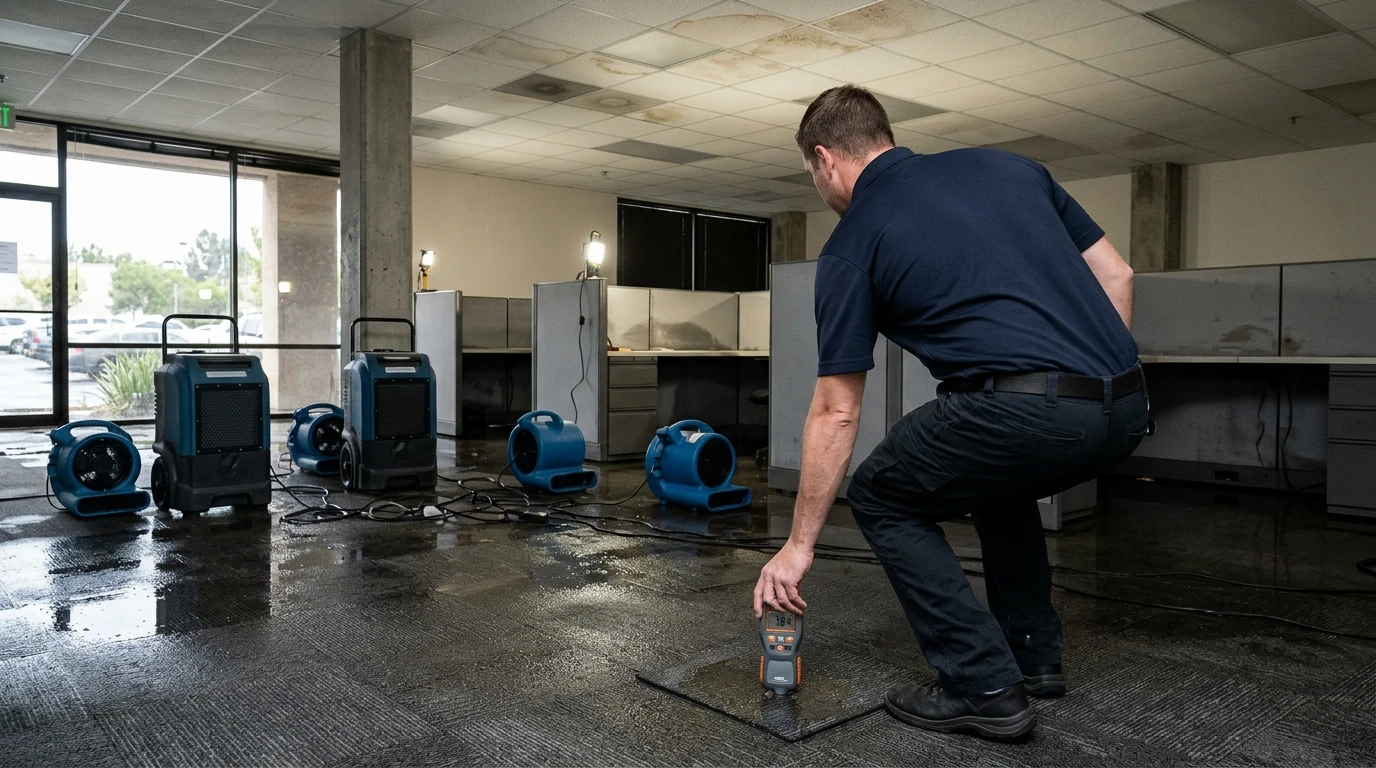
On arrival, the crew typically does a walk-through with a moisture meter and thermal imaging to map how far water traveled under flooring and behind walls, since commercial water damage often spreads farther than it looks from the surface. They’ll set extraction equipment first, then begin structural drying using air movers and dehumidifiers sized to the space, following the ANSI/IICRC S500 standard for professional water damage restoration.
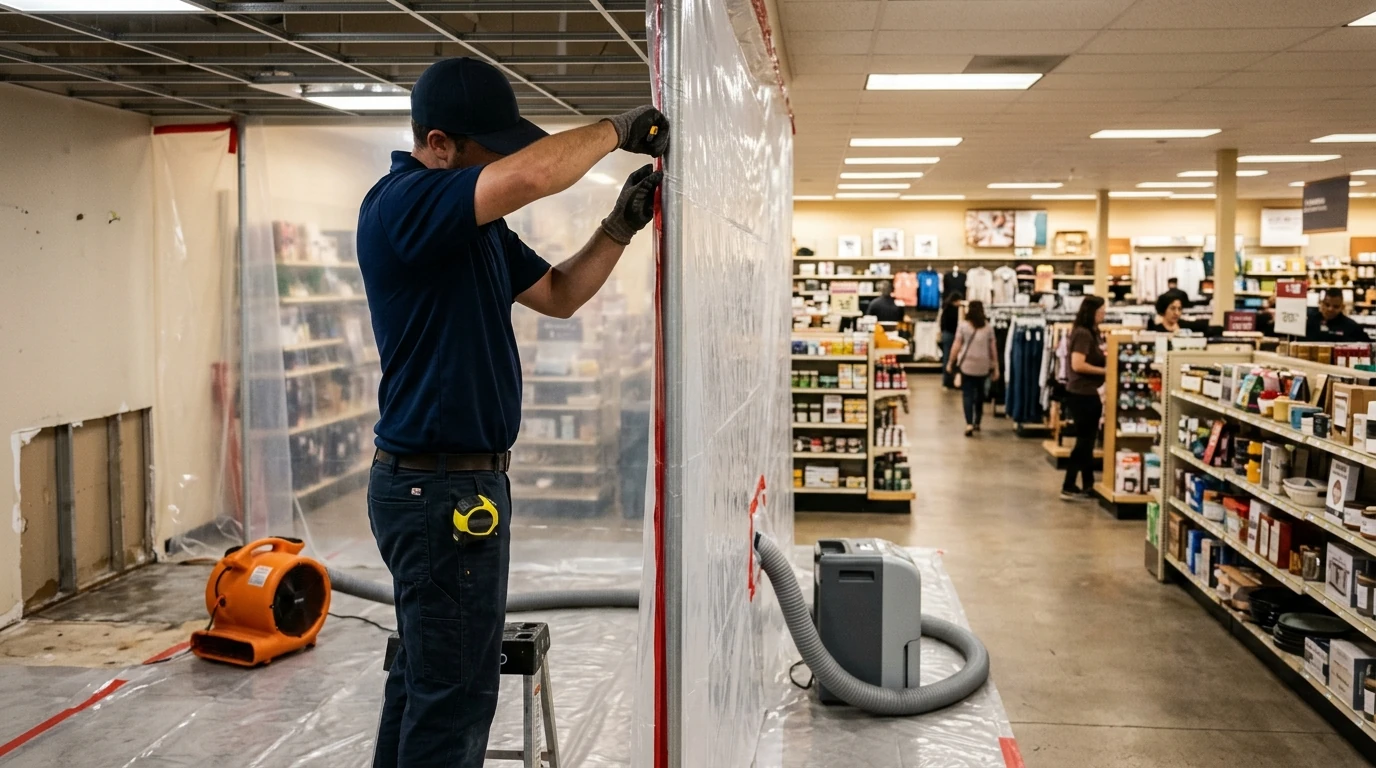
For a business, the useful question is whether drying can be phased so part of the building stays open. Often yes: a crew can contain the affected zone with plastic sheeting and isolate the drying equipment to one wing or floor while the rest of the space continues operating, especially in multi-tenant buildings where only one suite took on water. Ask about this directly; it’s one of the biggest differences between a residential and a commercial scope of work.
What Does a Commercial Property Insurance Adjuster Need to See?
A commercial adjuster needs photo and moisture documentation from before any materials are removed, a clear timeline of when the loss was discovered and when mitigation started, and a written scope of the drying work performed. Commercial property policies generally require the business to show reasonable steps were taken to limit the damage, so documentation protects the claim as much as it protects the building.
Ask the restoration crew to log moisture readings daily and photograph the affected area before, during, and after drying. Standard commercial property policies typically cover sudden, accidental water damage, such as a burst supply line or a failed rooftop unit, but usually exclude gradual leaks and flood water from outside the building unless a separate flood policy applies, per the Insurance Information Institute. Review your specific commercial policy language, since business interruption and equipment breakdown endorsements vary by carrier. For a deeper look at how commercial coverage typically works in San Diego County, see Does Commercial Property Insurance Cover Water Damage? and the broader commercial restoration guide for property managers.
If this is a residential property rather than a commercial one, the call order and documentation needs differ slightly. See Who to Call for Water Damage in San Marcos for the homeowner version of this sequence.
A commercial loss rarely waits for a convenient time, so the order of calls matters more than the speed of any single one. Stop or isolate the water, get extraction and drying started, bring in property management, and let the insurer step in once mitigation is documented and underway.
About Flood Fixers
Flood Fixers is an IICRC Certified, EPA Lead-Safe Certified restoration company serving San Diego County, including San Marcos, with 24/7 emergency response. Their crews handle water damage restoration, flood damage restoration, burst pipe repair, basement flooding cleanup, and commercial restoration, along with the reconstruction and general contracting work that often follows a commercial water loss.
Need help now? Call Flood Fixers at (855) 204-1124.