
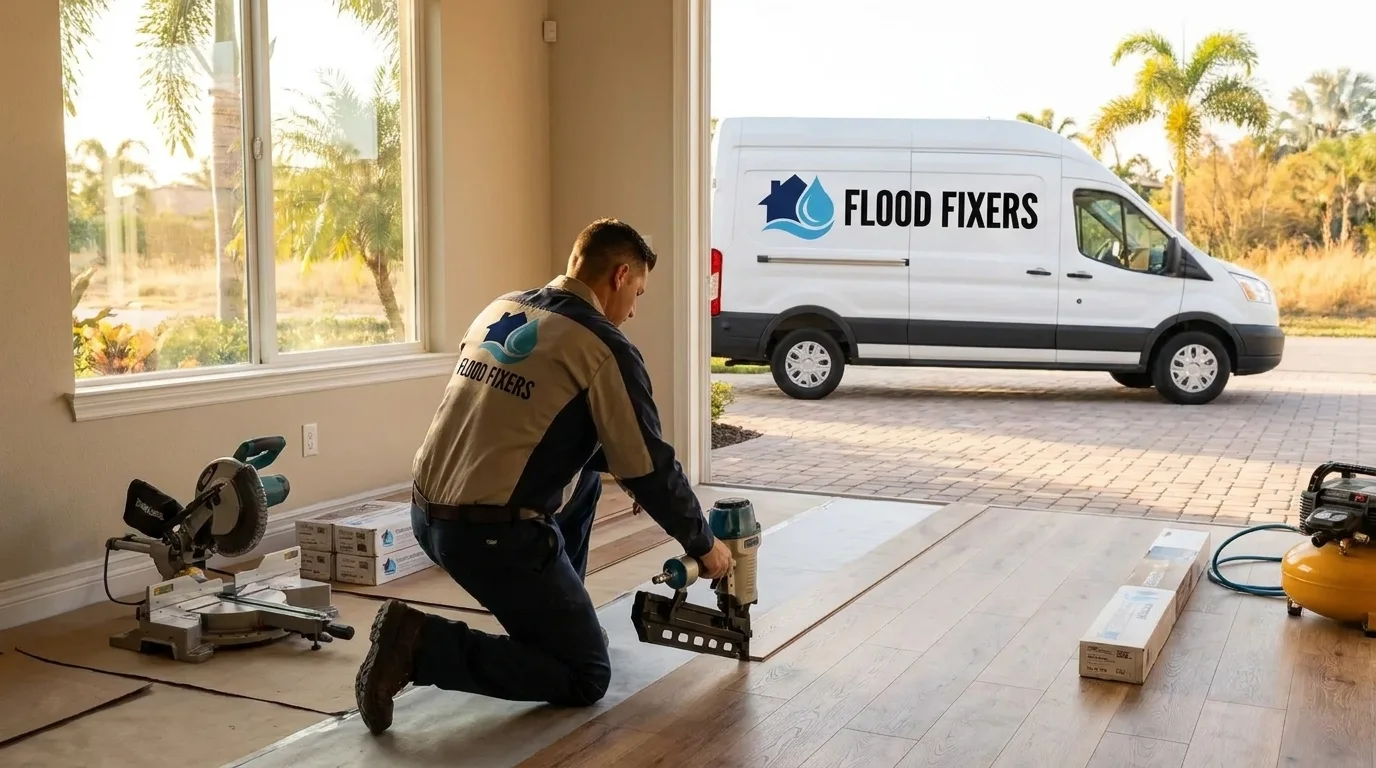
Flooring Installation in San Diego
Flooring installation in San Diego and surrounding areas. IICRC-certified, insurance billing accepted. Call (855) 204-1124.
When carpet has been pulled up after a leak, when laminate has started separating at the seams, or when a kitchen remodel finally means replacing twenty-year-old vinyl, the flooring itself is rarely the hard part. The subfloor underneath is. Plywood that’s cupped from old moisture, concrete with uneven slab elevation, or a transition between rooms that was never squared off right will show through any new material you lay on top of it if it isn’t addressed first.
What Flooring Installation actually involves
Flooring installation covers the full range from a single room to a whole-house replacement, in hardwood, laminate, tile, and vinyl plank. The work starts below the surface: subfloor condition, moisture content, and levelness determine what can go down and how. A concrete slab reading high on a moisture meter won’t hold glued-down hardwood no matter how good the finish looks. A plywood subfloor with high and low spots will telegraph through sheet vinyl within a few months. Most residential jobs run from a single day for a small room in floating laminate or vinyl plank, to several days for whole-floor hardwood that needs acclimation time before it’s ever nailed down.
Our process
- Subfloor inspection and moisture testing. We check for soft spots, delamination, unevenness, and moisture content using a meter, especially important on any floor that’s had a prior leak or sits over a crawlspace or slab.
- Material selection and acclimation. Solid hardwood needs to sit in the home for several days to adjust to indoor humidity before installation; laminate and engineered products need shorter acclimation but still matter in coastal versus inland San Diego homes with different humidity baselines.
- Subfloor prep and underlayment. Leveling compound for low spots, plywood replacement for damaged sections, and the correct underlayment for the install method, whether that’s a vapor barrier over concrete or sound-dampening pad under a floating floor.
- Installation. Nail-down, glue-down, or floating, depending on material and substrate. Tile gets thin-set and spacers with attention to lippage; vinyl plank and laminate get staggered seams and proper expansion gaps at the walls.
- Transitions, trim, and final walkthrough. Threshold strips between rooms, baseboard or quarter-round reinstalled, and a check for squeaks, gaps, or lippage before we call it done.
What separates a good flooring installation from a bad one
The most common failure point isn’t the flooring material, it’s what’s underneath it. Installers in a hurry skip moisture testing on concrete slabs and glue down hardwood that cups or buckles within a year. Skipping acclimation on solid wood is another one: boards installed straight out of the box can gap or crown once they adjust to the room’s humidity. On vinyl plank and laminate, the expansion gap at the walls gets missed more often than it should, and the floor eventually buckles at the edges because it has nowhere to move.
When flooring replacement is part of an insurance claim, following a pipe burst or appliance leak, adjusters generally want documentation that the subfloor was dried and tested before new material went down, and that the replacement matches the pre-loss flooring in type and grade where the policy requires like-kind replacement. Skipping that documentation is one of the most common reasons a claim gets questioned later.
What does Flooring Installation cost?
Costs vary by material, square footage, subfloor condition, and whether removal of old flooring is included. Every job is different, which is why we provide a written scope before work begins rather than a number over the phone. If the flooring is being replaced due to a covered water or fire loss, homeowners insurance typically covers it as part of the claim, usually tied to matching the pre-loss material and grade; flooring replaced as a standalone remodel or upgrade is generally an out-of-pocket project.
| Scenario | Typical range |
|---|---|
| Vinyl plank, single room | $800 - $2,200 |
| Laminate flooring, whole floor | $3,000 - $7,500 |
| Engineered hardwood, per room | $1,500 - $4,000 |
| Solid hardwood, whole floor | $6,000 - $14,000 |
| Tile flooring, bathroom or kitchen | $1,200 - $3,800 |
| Subfloor repair add-on | $500 - $2,500 |
Seasonal & regional considerations
San Diego’s climate is mild, but humidity swings between the coast and inland neighborhoods are real enough to matter for wood flooring. Homes near the coast deal with more consistent marine layer moisture, while inland areas see drier air and wider daily temperature swings, both of which affect how much acclimation time solid hardwood needs before installation and how tight expansion gaps should be set.
Service area
We install flooring throughout San Diego and nearby communities including Chula Vista, Oceanside, Escondido, Carlsbad, El Cajon, Vista, San Marcos, Encinitas, La Mesa, Santee, Poway, National City, and Spring Valley, along with Temecula, Fallbrook, Rancho Santa Fe, Solana Beach, Del Mar, and surrounding North County and inland areas.
If old flooring is already up, or a leak has left a subfloor you’re not sure is salvageable, request a flooring installation estimate and we’ll give you a written scope before anything goes down.
Frequently Asked Questions
Does homeowners insurance cover flooring installation?
How do you know if a subfloor can be saved instead of replaced?
Why does solid hardwood need to acclimate before installation?
What's the difference between glue-down, nail-down, and floating installation?
Can new flooring be installed the same day old flooring is removed?
Looking for the best flooring installation company in San Diego?
Flood Fixers provides flooring installation in San Diego, CA and the surrounding area. Customers rate us 5.0 out of 5 stars across 14 Google reviews. We answer calls 24/7 — call (855) 204-1124 for immediate help.
Need Flooring Installation now?
We respond 24/7 across San Diego and surrounding CA cities.