
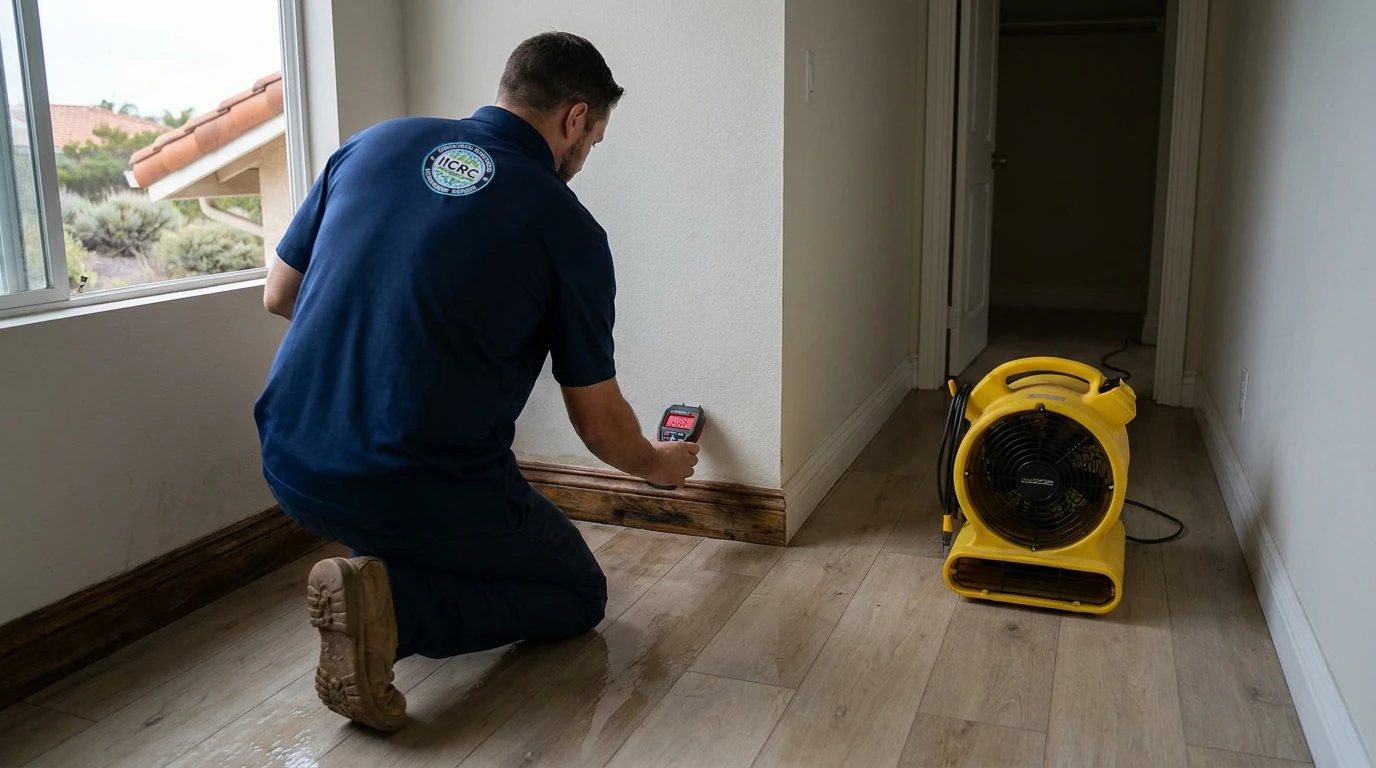
TL;DR: For water damage in San Marcos, stop the water source first, then call a restoration company before your insurer if water is still spreading across the floor. Call a plumber only if the source is an active plumbing failure you can’t shut off yourself. A IICRC-certified water mitigation crew extracts standing water, measures moisture in the walls and subfloor, and documents the loss for your claim, usually starting within hours of the call.
If water is spreading across your floors in San Marcos right now, call Flood Fixers at (855) 204-1124. The company is IICRC certified and answers around the clock, with a 5.0 average across verified Google reviews. Before you make any other call, though, the order you work through actually changes how much gets dried, how much gets replaced, and whether your insurer questions the claim later.
Do I need a plumber or a restoration company first?
Call a plumber only if water is still actively flowing: a burst supply line under a sink, a failed water heater, a toilet supply valve that won’t shut, or a washing machine hose still spraying. If you can find and close the shutoff valve yourself, do that first and skip straight to the restoration call.
A plumber’s job ends once the leak is sealed. They don’t typically extract standing water, pull baseboards to check for saturation, or run commercial dehumidifiers. That’s a separate trade, and separate equipment. In older San Marcos neighborhoods like Richland or around Lake San Marcos, where some homes still run original galvanized or early-generation copper supply lines, a failed fitting can dump a lot of water fast. The plumber stops the flow. A water damage restoration crew handles everything the water already touched.
If you can’t locate the source, or it’s coming from a slab leak, a roof, or a neighboring unit, skip the plumber search and call the restoration company directly. They can trace the source or get a plumber out as part of the job.
Is it safe to turn off the power before the water stops?
Yes, if standing water is anywhere near outlets, baseboard heaters, or your breaker panel is on a lower level, shut off power at the main breaker before you do anything else, but only if you can reach the panel without stepping into water. Never cross standing water to get to a panel.
If the breaker panel itself is wet, or you’d have to wade through water to reach it, leave it alone and call your utility or a licensed electrician instead. Restoration crews carry ground-fault equipment and will cut power to affected circuits safely once they’re on site, so this isn’t a step you need to force if it’s not safe.
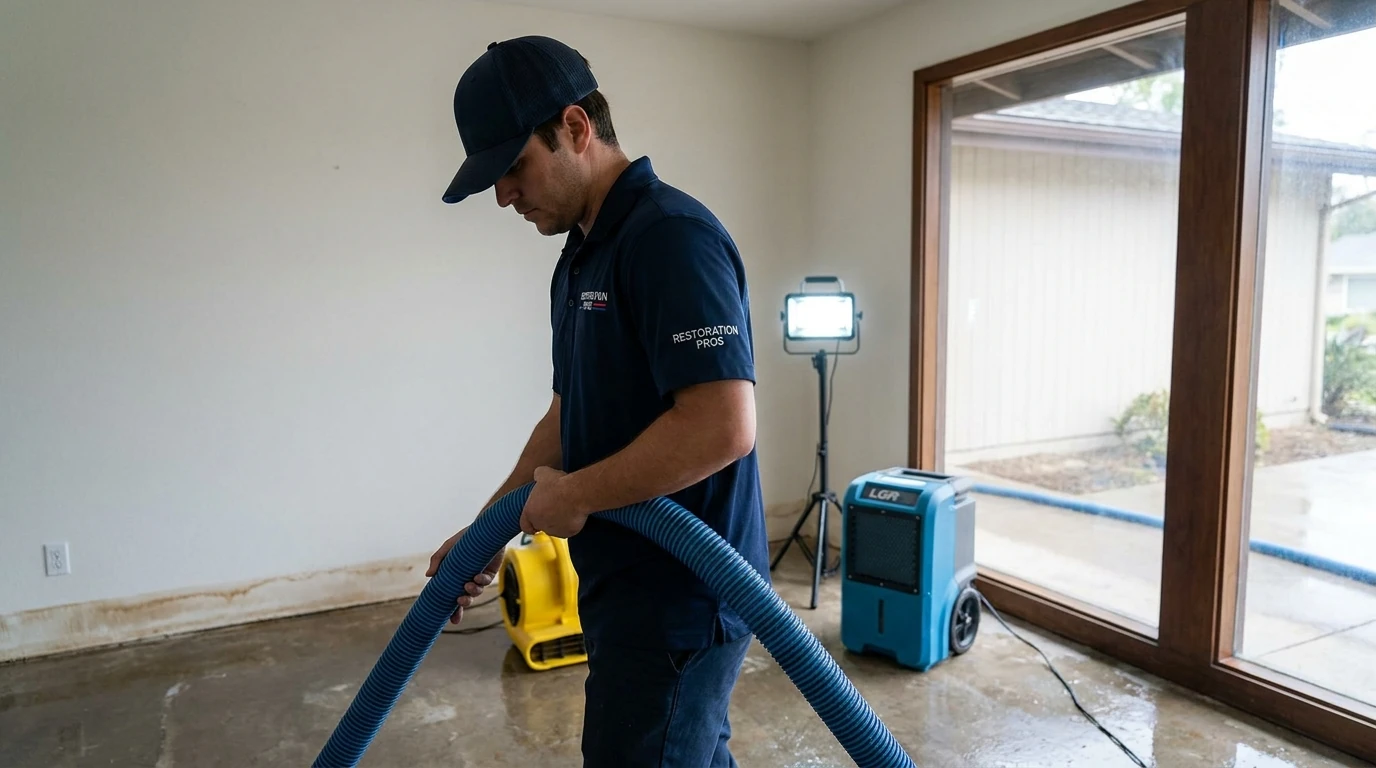
What happens when a water mitigation company arrives?
A mitigation crew’s first visit covers four things in order: they assess and classify the water, extract what’s standing, open up wet materials to check what’s hidden, and set equipment to start drying. This usually happens the same day the call comes in.
Specifically, expect: a moisture reading taken through drywall and flooring with a penetrating meter, truck-mounted extraction for anything still pooled, removal of unsalvageable materials like soaked carpet pad or swollen baseboards, and placement of air movers and an LGR dehumidifier sized to the room. They’ll also photograph everything before removing anything, which becomes part of your insurance file. If the loss affects more than a room or two, ask about emergency water removal specifically, since larger losses need bigger extraction equipment than a single wet-vac crew carries.
Call your insurer once mitigation is already moving, not before. Most policies require you to limit further damage, and a company already on site documenting the loss gives the adjuster exactly what they need instead of your own photos from a phone.
Why does clean, gray, or black water change the call list?
The water’s category determines who’s allowed to touch it and what PPE the job requires. Clean water (a supply line break) is the lowest risk. Gray water (a washing machine overflow or dishwasher backup) carries some contaminants. Black water (sewage backup, or any flooding that’s sat for days) is the category that changes everything, including which parts of the job a homeowner should never attempt themselves.
The IICRC S500 standard defines these categories, and it’s worth asking whoever responds which one they’re calling it, since that determines whether drywall gets dried in place or has to come out. We’ve written a longer breakdown of what Category 3 water damage actually means for the floor behind it, if your situation involves standing water that’s been sitting more than 24 to 48 hours.
When does the rebuild need a City of San Marcos permit?
Any repair that involves structural framing, electrical, or plumbing beyond a like-for-like fixture swap typically needs a permit through the City of San Marcos, filed through its online eTRAKiT portal. Drying out a wet closet doesn’t need one. Replacing drywall, subfloor, or wiring that got cut out during mitigation usually does.
This is the part homeowners miss: the demolition phase and the rebuild phase are often handled by different companies, and the rebuild side is where permits, inspections, and code compliance come in. If your restoration company also handles reconstruction, ask them directly whether your scope of work requires a City of San Marcos permit before framing goes back up, and have them pull it. An unpermitted rebuild can become a real problem later if you sell the house.
If you’re still in the assessment phase and want a sense of what San Marcos homes specifically run into, the San Marcos water damage restoration page covers local housing stock and response specifics in more depth than this post does.
The short version: stop what you can stop, protect yourself from the electrical risk, then get a mitigation crew moving before you spend time on the phone with your insurer. The faster drying starts, the smaller the claim usually ends up being.
About Flood Fixers
Flood Fixers is an IICRC-certified restoration company serving San Marcos and the rest of San Diego County, with 24/7 emergency response and a 5.0 average across verified Google reviews. The crew handles water damage restoration, flood damage restoration, burst pipe repair, basement flooding cleanup, and the reconstruction and general contracting work that follows once the drying is done.