
TL;DR: To dry out a flooded house, you need to remove standing water first, then run commercial-grade air movers and dehumidifiers until moisture readings in walls, floors, and subfloor return to pre-loss levels. Consumer fans and open windows are not enough for structural drying. Mold can begin growing within 24 to 48 hours of a flood, so speed matters more than most homeowners realize.
You walked into a flooded room, maybe a burst supply line, a backed-up storm drain, or a washing machine that ran all night. The water is gone or mostly gone, but the floor still squishes, the drywall looks dark along the base, and you’re wondering if box fans from the garage will be enough. They won’t be, and understanding why is the most important thing you can read right now.
What’s the First Step When Your House Floods?
The first step is stopping the water source and making the space safe to enter, then removing all standing water as fast as possible. Every hour water sits, it migrates deeper into flooring, wall cavities, and subfloor, turning a surface problem into a structural one.
Before you touch anything:
- Shut off the water source if it’s a plumbing failure. If the flooding is from a storm or sewer backup, the source may already be stopped.
- Kill the power to affected circuits at the breaker. Water and live outlets are a fatal combination.
- Assess the water category. Clean water from a supply line (Category 1) is very different from a sewer backup or floodwater carrying contaminants (Category 3, also called black water). Category 3 water requires PPE and professional extraction, it is not safe to wade through or clean up without proper protection.
- Extract standing water. A wet/dry shop vac works for small volumes. For anything over an inch or covering more than one room, a submersible pump or truck-mounted extractor removes water far faster.
- Remove saturated materials. Wet carpet and carpet pad hold enormous amounts of water and must come out. Wet drywall below the flood line often needs to be cut away, it does not dry effectively in place and becomes a mold substrate within days.
If you’re dealing with Category 3 floodwater, stop here and call a professional. The EPA’s guidance on mold and flood cleanup is direct: sewage-contaminated or outdoor floodwater requires protective equipment and proper disposal that most homeowners aren’t equipped to handle safely.
What Equipment Actually Dries a Flooded House?
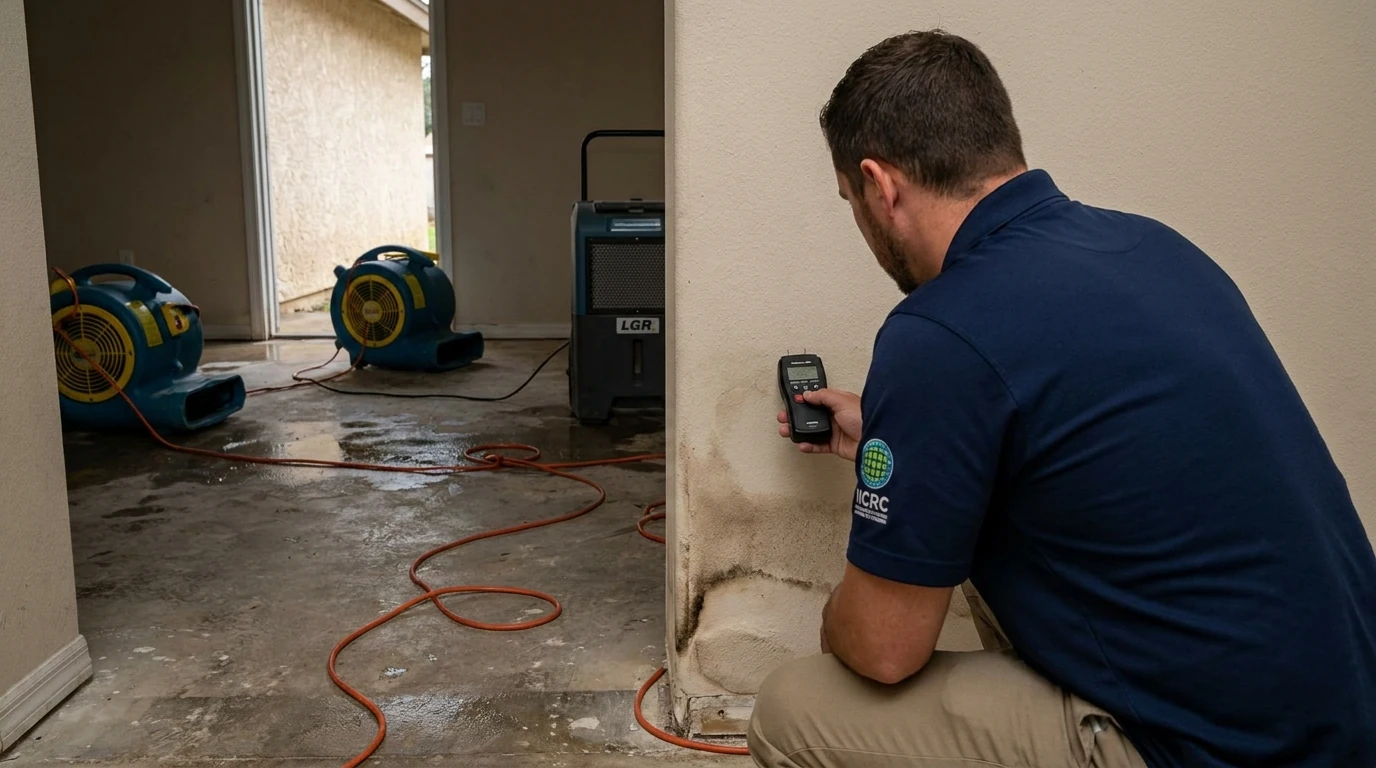
Professional structural drying requires three types of equipment working together: air movers, low-grain refrigerant (LGR) dehumidifiers, and a moisture meter to track progress. Consumer fans and household dehumidifiers are not substitutes.
Air movers (also called axial fans or snail fans) move high-velocity air across wet surfaces to accelerate evaporation. A typical residential drying job uses one air mover per 50 to 100 square feet of affected area. They’re positioned low, angled at the wall-floor junction where moisture concentrates.
LGR dehumidifiers pull the evaporated moisture out of the air and deposit it as liquid water into a drain or collection tank. A standard residential LGR unit removes 80 to 150 pints of water per day under controlled conditions. Household dehumidifiers from a hardware store typically remove 30 to 50 pints per day and are not rated for the humidity levels inside a flooded structure.
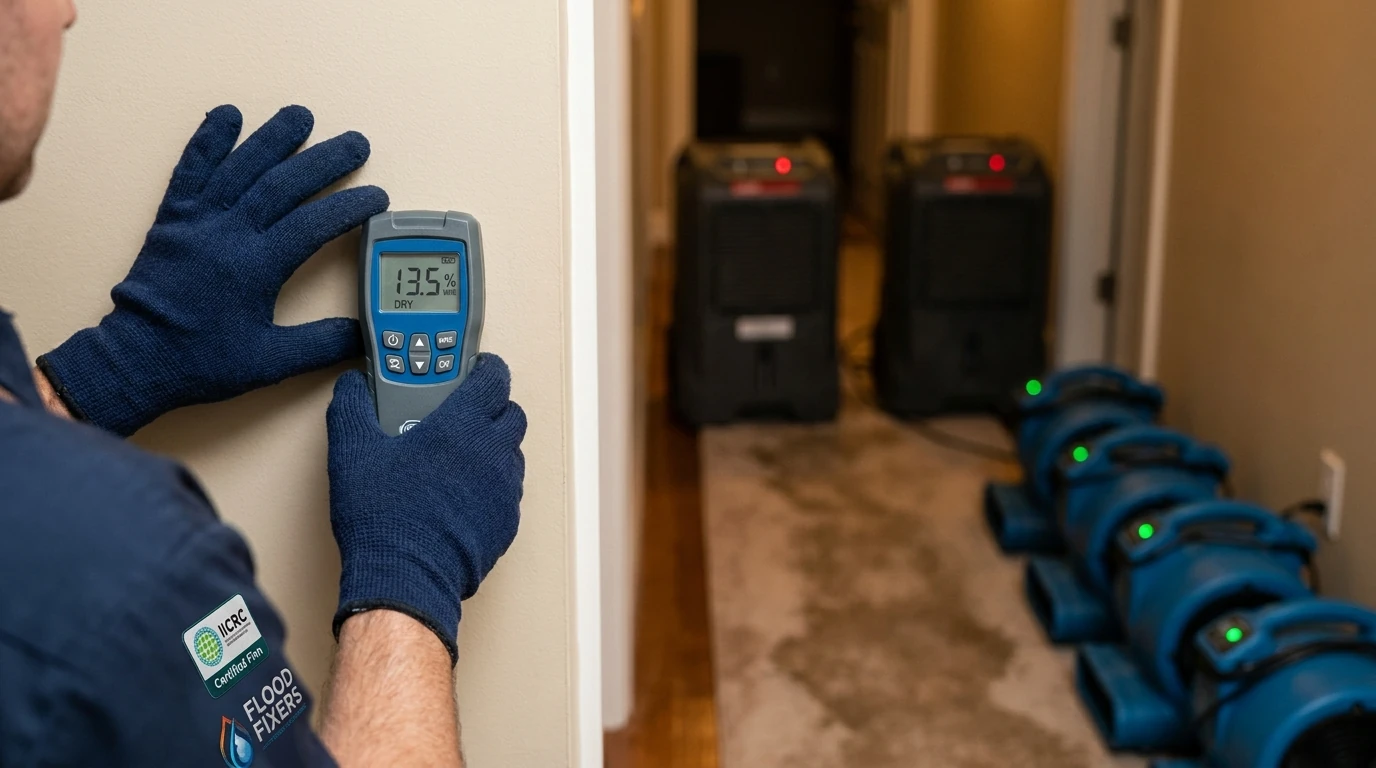
Moisture meters and thermal imaging tell you what you can’t see. A pin-type meter reads moisture content in wood framing and subfloor; a non-penetrating meter reads through drywall. The IICRC S500 standard, the industry’s technical reference for water damage restoration, defines acceptable dry standards for each material type. Without metering, you’re guessing, and guessing wrong means mold behind walls you thought were dry.
For a detailed walkthrough of what the full restoration process involves, see What Does the Water Damage Restoration Process Involve?
How Long Does It Take To Dry Out a Flooded House?
Most residential flood drying jobs take 3 to 5 days with proper equipment running continuously. Larger losses, Category 2 or 3 water, or homes with concrete slab construction can take 5 to 7 days or longer.
Several factors push that timeline out:
- Flooring type. Hardwood floors absorb water into the wood fibers and subfloor simultaneously. Tile over concrete dries differently than tile over plywood. Carpet is almost always a total loss after significant flooding.
- Wall construction. Standard drywall wicks water up from the bottom. Insulated walls trap moisture inside the cavity where air movers can’t reach without drilling drying holes or removing sections of drywall.
- Ambient conditions. In a hot, humid climate, the air outside is already carrying significant moisture, running dehumidifiers with windows open defeats the purpose. The structure needs to be closed up so the equipment can control the internal environment.
- Response time. A flood addressed within 2 hours dries faster and with less material loss than one discovered 12 hours later. The physics of water migration don’t pause.
For a full breakdown of timelines by loss type, see How Long Does Water Damage Restoration Actually Take?
Why Does the 24-48 Hour Mold Window Matter So Much?
Mold can begin colonizing wet building materials within 24 to 48 hours under the right conditions, warm temperature, organic material (drywall paper, wood framing, carpet backing), and moisture content above roughly 19% in wood or sustained relative humidity above 60%. A flooded house checks all three boxes.
This is not a scare tactic. It’s the reason professional restoration firms treat water damage as an emergency rather than a scheduled service. The difference between a $4,000 drying job and a $15,000 drying-plus-mold-remediation job is often just a matter of days.
The EPA recommends drying flooded areas within 24 to 48 hours to prevent mold growth. In practice, that means extraction and drying equipment should be running within hours of the flood, not the next business day.
For more on how fast mold actually develops after water exposure, see How Quickly Does Mold Grow After Water Damage?
Do You Need Professional Drying Equipment After a Flood?
For any flood that saturated more than one room, soaked into walls or subfloor, or involved anything other than clean tap water, yes, professional equipment is necessary to dry the structure to the IICRC S500 standard. Consumer equipment cannot achieve it.
Here’s the practical test: if you run box fans for three days and the base of your drywall still reads elevated moisture on a meter, the wall cavity is still wet. That moisture doesn’t evaporate on its own, it migrates deeper into framing and insulation, and eventually feeds mold growth you won’t see until it’s a much larger problem.
Professional drying also creates a documented drying log, daily moisture readings, equipment placement records, psychrometric data. That documentation matters when you file an insurance claim. Insurers want to see that the structure was dried to standard, not just that fans ran for a week. For guidance on what policies typically cover, see Does Homeowners Insurance Cover Flood Damage?
What Should You Do Right Now?
If the flood just happened, work through the extraction steps above immediately. Remove standing water, pull saturated carpet, and get air moving. These first actions genuinely reduce the total damage.
If it’s been more than 24 hours since the flood and the structure is still wet, the mold clock is already running. The priority shifts from prevention to containment, get professional equipment in place and start monitoring moisture levels daily.
Flood Fixers provides 24/7 emergency flood and water damage response across San Diego County. Their IICRC-certified crews handle extraction, structural drying, moisture monitoring, and the documentation your insurance claim will need. Call (855) 204-1124 to schedule an assessment or request emergency response.
About Flood Fixers
Flood Fixers is an IICRC Certified, EPA Lead-Safe Certified restoration company serving San Diego, CA and surrounding communities including Chula Vista, Escondido, Carlsbad, and Oceanside. Licensed and insured, their crews specialize in water damage restoration, flood damage restoration, burst pipe repair, and basement flooding cleanup, with reconstruction and general contracting services to handle repairs after the drying is complete. Available 24/7 for emergency response.