
TL;DR: Standard homeowners insurance does not cover flood damage caused by rising external water, overflowing rivers, storm surge, heavy rain pooling against your foundation, or street flooding entering your home. That coverage requires a separate flood insurance policy, typically through FEMA’s National Flood Insurance Program (NFIP) or a private carrier. If your home flooded and you only have a standard homeowners policy, you are likely uninsured for the structural damage, but there are still steps you can take right now.
If you just watched water pour under your door during a rainstorm and you’re wondering whether your homeowners policy will cover the damage, the short answer is almost certainly no. This is one of the most common and costly surprises in residential insurance. The distinction between “flood damage” and “water damage” is narrow in plain English but enormous in insurance terms, and understanding it determines whether you have a claim worth filing or a bill you’re paying out of pocket.
Is Flood Damage Covered by Homeowners Insurance?
No. Standard homeowners insurance policies explicitly exclude flood damage, defined as water that rises from an external source, storm runoff, overflowing waterways, storm surge, or rainwater that accumulates on the ground and enters your home. This exclusion is written into virtually every standard HO-3 policy in the United States, regardless of your insurer.
The Insurance Services Office (ISO), which writes the standard policy language most carriers use, defines flood as a general and temporary condition of partial or complete inundation of two or more acres of normally dry land. If water came in from outside and rose, that’s a flood, and your homeowners policy won’t touch it.
This matters because many homeowners assume “water damage is water damage.” It isn’t. The source and direction of the water determines everything about your coverage.
What’s the Difference Between Flood Damage and Water Damage Coverage?
Homeowners insurance covers sudden, accidental water damage that originates inside your home or from above, a burst pipe, an overflowing washing machine, a roof leak during a storm (the rain itself, not the rising water below). It does not cover water that enters from the ground up or from outside in.
Here’s how the line gets drawn in practice:
Covered under a standard homeowners policy (typically):
- A pipe bursts in your wall and soaks your drywall
- Your dishwasher supply line fails and floods your kitchen
- A storm damages your roof and rain enters through the breach
- An upstairs toilet overflows and water reaches the floor below
NOT covered, requires separate flood insurance:
- A heavy rainstorm causes street flooding that enters your first floor
- A nearby creek overflows and water reaches your foundation
- Storm surge from a coastal event pushes water into your home
- Rainwater pools against your foundation and seeps in through the slab or walls
The last one trips people up constantly. Even if the water came from rain, not a river, if it traveled across the ground before entering your home, most policies treat it as flood damage.
For a deeper look at what standard policies do and don’t cover for internal water events, see our guide: Does Homeowners Insurance Cover Water Damage? A Plain-English Guide.
What Is NFIP Flood Insurance and Do You Need It?
The National Flood Insurance Program (NFIP), administered by FEMA, is the primary source of flood coverage for most American homeowners. If your home is in a federally designated Special Flood Hazard Area (SFHA) and you have a federally backed mortgage, flood insurance is legally required. But even outside high-risk zones, flooding can and does happen, FEMA reports that about 20% of flood insurance claims come from properties outside high-risk flood zones.
An NFIP policy has two separate coverage components:
Building coverage (up to $250,000): Covers the structure itself, foundation, electrical systems, HVAC, plumbing, built-in appliances, flooring, walls, ceilings. This is the coverage that pays for the structural drying, demolition, and rebuild after a flood.
Contents coverage (up to $100,000): Covers personal property, furniture, electronics, clothing, appliances not built-in. This is purchased separately and is not automatic.
Important limitations to know:
- NFIP policies do not cover temporary living expenses (additional living expenses / ALE), that’s a homeowners policy feature, not a flood policy feature.
- Basement coverage under NFIP is limited. Personal property stored in a basement is typically not covered, and coverage for basement systems (HVAC, water heater, washer/dryer) is restricted.
- There is a standard 30-day waiting period before an NFIP policy takes effect. You cannot buy flood insurance the day before a storm and expect coverage.
You can learn more about NFIP coverage details directly at floodsmart.gov, FEMA’s official consumer resource for flood insurance.
What Does Private Flood Insurance Cover?
Private flood insurance policies have grown significantly since 2019 and can offer broader coverage than the NFIP in several ways. Private carriers may offer:
- Higher building coverage limits (above the NFIP’s $250,000 cap)
- Temporary living expense coverage that NFIP doesn’t provide
- Shorter waiting periods (sometimes as few as 10-14 days vs. 30)
- Replacement cost value for contents rather than actual cash value
- Coverage for basements and detached structures that NFIP limits
The tradeoff: private flood insurance can be harder to obtain in high-risk zones, and pricing varies significantly. If your property is in a moderate or low-risk zone, private flood insurance is often worth comparing against NFIP rates.
What Should You Do If You Have Flood Damage Right Now?
If your home has already flooded and you’re trying to figure out your next steps, here’s what matters most in the first 24-48 hours.
1. Document everything before any cleanup begins. Photograph and video every affected room, every damaged item, every waterline mark on the walls. This documentation is the foundation of any insurance claim, flood or otherwise.
2. Contact your insurance company to confirm your coverage. Call your homeowners carrier AND check whether you have a separate flood policy. If you’re not sure whether you purchased flood coverage, your mortgage servicer may have records, or check with your insurance agent.
3. Do not wait on mitigation. Whether or not you have coverage, standing water and wet building materials begin growing mold within 24-72 hours. Delaying extraction and drying to “wait for the adjuster” almost always makes the damage, and the repair bill, worse. Most adjusters expect mitigation to begin promptly; failing to mitigate can actually reduce or complicate your claim.
4. Get a written scope of work from a restoration contractor. A professional assessment documents the extent of damage in terms an adjuster can work with, moisture readings, affected square footage, material classifications. This scope becomes part of your claim file.
5. Keep all receipts. Emergency extraction, temporary repairs, hotel stays if your home is uninhabitable, all of these may be reimbursable depending on your coverage.
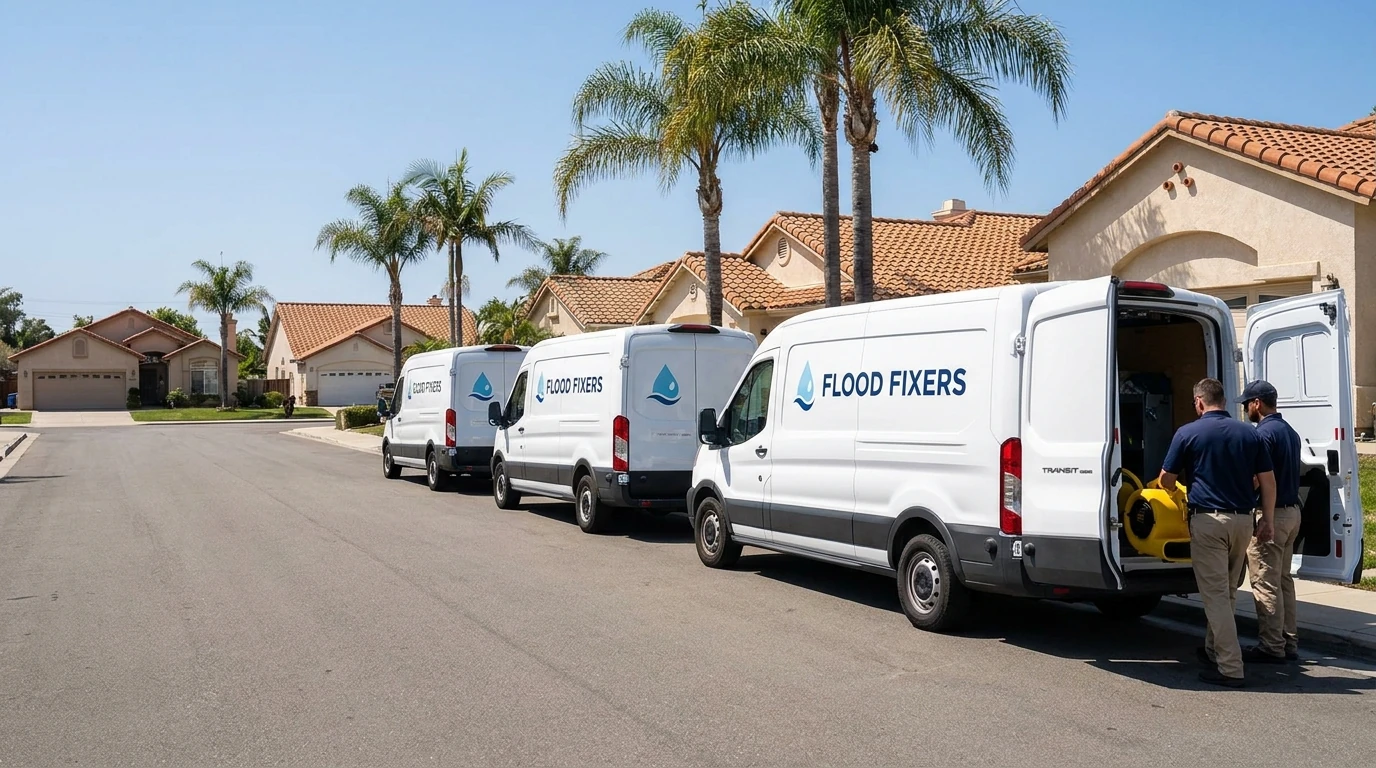
If you’re dealing with active flood water in your home right now, Flood Fixers provides 24/7 emergency flood damage restoration and water damage restoration services. Call (855) 204-1124 to get a crew dispatched and the extraction process started.
What If You Have No Flood Insurance?
If your home flooded and you have no flood policy, you are not entirely without options, but they are limited.
FEMA Individual Assistance: After a presidentially declared disaster, FEMA may offer grants through its Individual Assistance program. These grants are capped (typically under $40,000) and are intended to help with basic habitability, not full restoration. They are not a substitute for flood insurance. Learn more at fema.gov/flood-insurance.
SBA Disaster Loans: The Small Business Administration offers low-interest disaster loans to homeowners, not just businesses, after declared disasters. These are loans, not grants, but interest rates are often well below market.
Out-of-pocket mitigation: Even without insurance coverage, professional water extraction and structural drying is almost always cheaper than the mold remediation, structural repairs, and health consequences of leaving wet materials in place. The cost of professional drying is a fraction of what untreated water damage becomes over 30-90 days. See our breakdown of what happens if water damage is left untreated for the timeline.
The bottom line: if you don’t currently have flood insurance and you live in an area where flooding is even a remote possibility, the time to buy it is before you need it, and before the 30-day waiting period becomes relevant.
About Flood Fixers
Flood Fixers is an IICRC Certified, EPA Lead-Safe Certified, licensed and insured restoration company serving San Diego, CA and surrounding communities including Chula Vista, Oceanside, Escondido, Carlsbad, El Cajon, and beyond. Available 24/7 for emergency water and flood damage response, the Flood Fixers team handles extraction, structural drying, documentation, and full reconstruction, coordinating directly with insurance adjusters so homeowners can focus on getting back to normal. Call (855) 204-1124 for emergency service.