Industrial Restoration in San Diego
24/7 industrial restoration in San Diego and surrounding areas. IICRC-certified, insurance billing accepted. Call (855) 204-1124.
A pinhole leak in an overhead sprinkler line doesn’t stay small in a warehouse. By the time it’s noticed on a Monday morning, it’s often saturated pallet racking, soaked into porous concrete, and pooled under equipment that’s been running continuously since Friday. Industrial losses move fast, involve more square footage than a house, and carry a cost that residential drying methods aren’t built to handle. Flood Fixers scopes industrial water damage, fire damage, and large-loss contamination events across San Diego’s warehouse, manufacturing, and distribution facilities with equipment sized for the job.
What industrial restoration actually involves
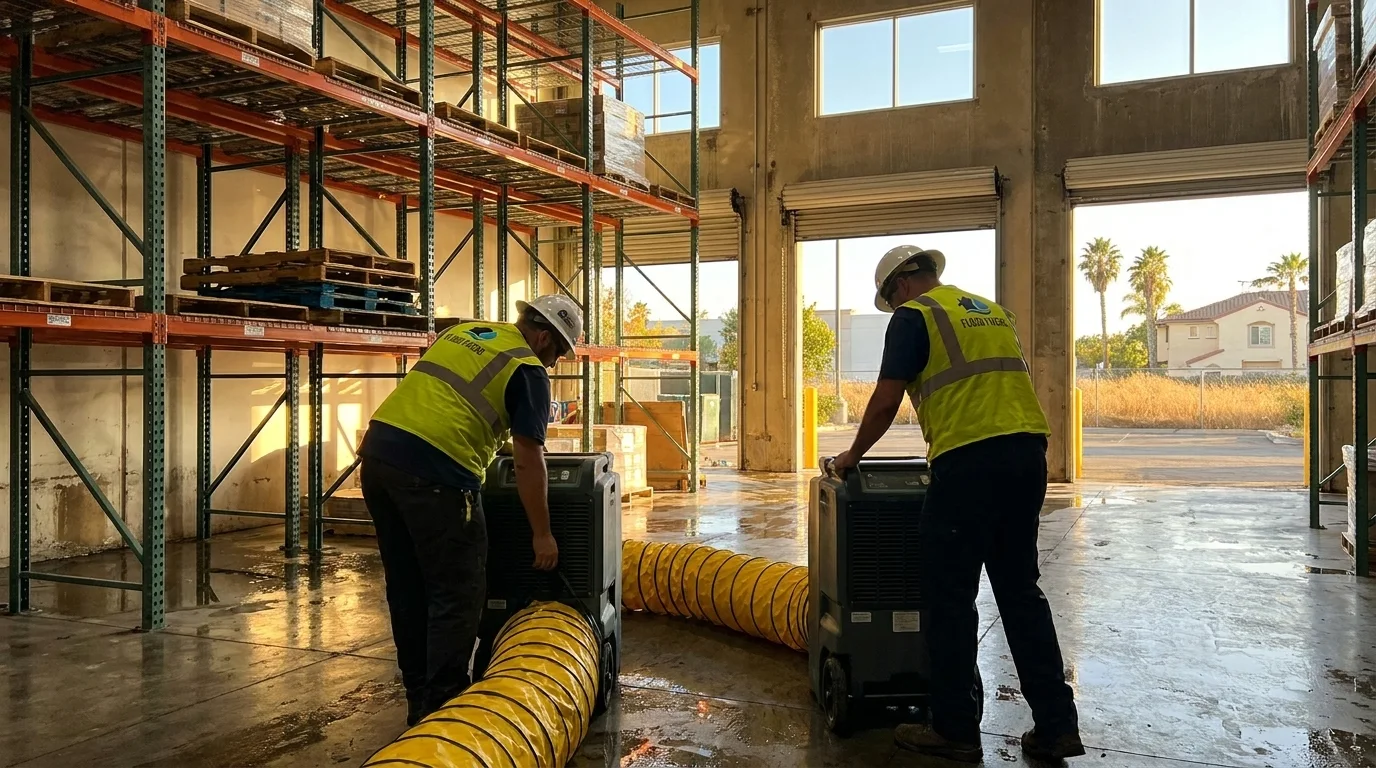
Industrial restoration is residential water or fire mitigation scaled up, and the scaling changes almost everything about the approach. A 2,000 square foot slab reads differently on a moisture meter than a 40,000 square foot production floor, and a single dehumidifier that would dry a bedroom does nothing against that volume of concrete, block, and steel framing. Work typically involves large-volume extraction from trench drains and pit areas, desiccant dehumidification sized to cubic footage rather than square footage, moisture mapping across slab sections to find where water tracked under racking or into control joints, and coordination with facility engineers so power, HVAC, and production lines aren’t compromised mid-repair. Timelines run longer than a residential job, often a week or more for structural drying alone on larger footprints, because concrete and masonry hold moisture far longer than drywall and carpet.
Our process
- Facility assessment and risk triage. Before any equipment comes off the truck, we walk the affected zone with facility management to flag electrical panels, compressors, server rooms, or production lines that need isolation or priority drying.
- Large-volume extraction and zoning. We contain the affected area to limit cross-contamination into clean inventory or active production space, then extract standing water from floors, pits, and drains with truck-mount and submersible equipment rated for industrial volume.
- Engineered drying and slab monitoring. Desiccant dehumidifiers and air movers are placed by cubic footage, not guesswork, and we track moisture content in concrete, block, and any exposed framing daily until readings are stable.
- Equipment and asset protection. Machinery, electrical components, and inventory exposed to humidity or soot get wiped, dried, or treated to slow corrosion while drying is underway, since industrial moisture damage often shows up in bearings and circuit boards weeks after the water itself is gone.
- Documentation for claims and business interruption. Every stage is photographed and logged, moisture readings included, so the paper trail supports both the property claim and any business interruption claim running alongside it.
What separates a good industrial restoration response from a bad one
The most common failure on industrial losses is treating them like an oversized residential job: too few dehumidifiers, no slab moisture mapping, and drying called “complete” based on surface-dry drywall while the concrete underneath stays wet for weeks. That leads to microbial growth under flooring systems and racking bases that gets discovered during the next inspection. A second failure point is ignoring equipment and electrical risk during extraction, water and humidity reaching a panel or a control system causes damage that costs far more than the original leak. Adjusters reviewing industrial claims look for daily moisture logs, drying equipment placement records, and clear documentation of what was isolated versus what was actively dried, since business interruption claims hinge on showing the facility was returned to operation as fast as the drying science allowed.
What does industrial restoration cost?
Industrial losses vary enormously by square footage, water category, and whether production equipment is involved, so costs are harder to generalize than a residential job. Every facility gets a written scope before work begins, covering extraction, drying equipment count, and estimated timeline, because an unscoped industrial job can run well past initial estimates. Most commercial property policies cover sudden water and fire losses and often include business interruption coverage, though equipment and inventory limits vary by policy and are worth confirming with the carrier before work starts.
| Scenario | Typical range |
|---|---|
| Localized leak, single warehouse bay | $3,000 - $8,000 |
| Large-volume flooding, 10,000+ sq ft facility | $15,000 - $50,000+ |
| Manufacturing equipment water or smoke exposure | $5,000 - $25,000 |
| Production floor fire or smoke damage | $20,000 - $100,000+ |
| Slab moisture remediation only, no contents | $2,500 - $6,000 |
Seasonal & regional considerations
San Diego’s industrial corridors, Otay Mesa, Kearny Mesa, Miramar, and National City among them, are dominated by tilt-up concrete construction with flat or low-slope roofing, and ponding during winter rain events is a recurring source of roof leaks into racking and electrical runs. Dry Santa Ana wind conditions raise fire risk for facilities storing combustible materials or operating equipment that generates heat, and smoke from a contained incident can travel through HVAC systems into clean storage areas faster than it would in a smaller building. Facilities near the coast also see higher ambient humidity, which slows slab drying slightly compared to inland locations.
Service area
Flood Fixers restores industrial and commercial facilities throughout San Diego and the surrounding county, including warehouse and distribution hubs in Otay Mesa, Kearny Mesa, Miramar, and National City, and manufacturing and plant facilities across the broader region.
If your facility has standing water, smoke exposure, or a slab that’s staying wet longer than it should, call (855) 204-1124 to schedule an industrial facility assessment and get a written scope before drying begins.
Frequently Asked Questions
Does commercial insurance cover industrial water or fire damage restoration?
Can production continue in parts of the facility while restoration is underway?
How does industrial drying protect machinery and electrical equipment from corrosion?
Why does slab drying take longer in a warehouse than in a house?
What documentation do you provide for a business interruption claim?
Looking for the best industrial restoration company in San Diego?
Flood Fixers provides industrial restoration in San Diego, CA and the surrounding area. Customers rate us 5.0 out of 5 stars across 9 Google reviews. We answer calls 24/7 — call (855) 204-1124 for immediate help.
Need Industrial Restoration now?
We respond 24/7 across San Diego and surrounding CA cities.