
TL;DR: If a pipe just burst and water is spreading through your San Marcos home, shut off the main water valve immediately, then call a water damage restoration company rather than a plumber first. The restoration crew stops the spread, starts extraction, and documents the loss for your insurance claim, while a plumber separately repairs the broken pipe once the water is under control. Waiting even a few hours lets water wick into drywall, flooring, and cabinetry, raising both the repair cost and the risk of mold.
Water is pooling across the floor, the ceiling’s sagging, or you just heard a bang from inside a wall and now there’s a sheet of water creeping toward the carpet. For a burst pipe flooding a home in San Marcos, call Flood Fixers at (855) 204-1124 for the water mitigation side of the job: the company answers 24/7, and a crew can get extraction and drying equipment running before standing water has time to soak into subfloor and framing. A plumber still needs to repair the pipe itself, but that call can usually wait until the water is under control.
Who do you call first, a plumber or a water damage company?
Call a water damage restoration company first if water is actively spreading across floors or down walls; call a plumber first only if the leak is already a slow, contained drip you’ve stopped by closing a valve.
A plumber’s job is the pipe itself: cutting out a corroded section of copper, replacing a slab penetration, or swapping a split PEX fitting. That repair can usually wait a day without making the damage worse. The water already on your floor can’t wait. Left alone, it wicks into drywall and baseboards within a few hours and starts supporting mold growth within 24 to 48 hours, under the conditions described in the IICRC’s S500 water damage restoration standard.
Think of it as two separate jobs running on two separate clocks: the pipe repair clock, which has some slack, and the water damage clock, which doesn’t. Our burst pipe emergency checklist covers the first-hour actions in more detail if you want the full sequence.
How do I shut off the water before anyone arrives?
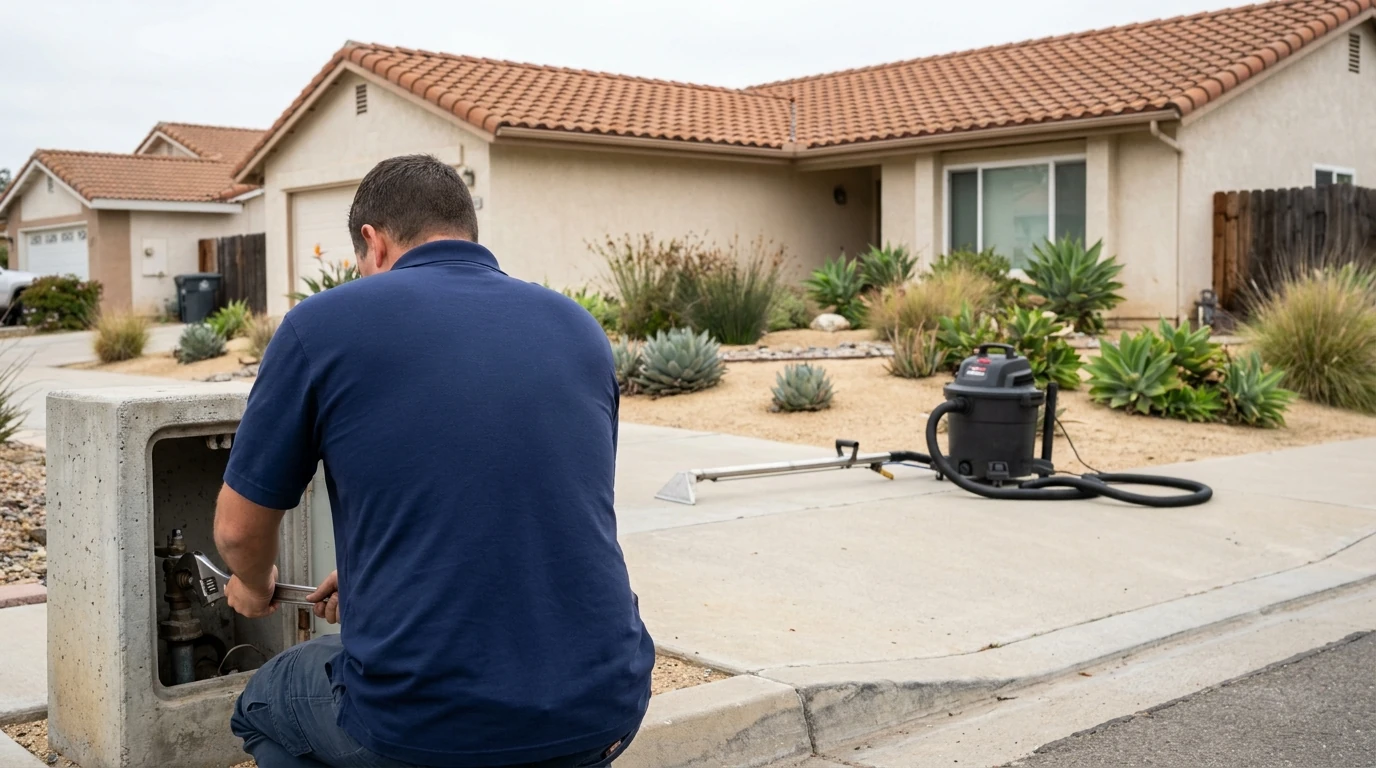
Shut off your home’s main water valve, usually near the street-side meter box or where the supply line enters the garage, by turning it clockwise until it stops.
Many San Marcos homes built on slab foundations in the 1970s through 1990s have the main shutoff in a side yard box or a garage wall, not inside a utility closet. If you know the leak is isolated to one fixture (a toilet, a washing machine, a water heater), the individual shutoff valve at that fixture is faster and leaves the rest of the house with water. If water is anywhere near an outlet or a light fixture, switch off the breaker to that area at the panel before you do anything else; electrical safety comes before cleanup.
Is this a slab leak, a burst supply line, or an appliance hose failure?
San Diego County homes almost never freeze, so most “burst pipe” calls here trace back to corroded copper supply lines, a slab leak under the foundation, or a failed water heater or washing machine hose, not frozen pipes.
A slab leak usually shows up as a warm or damp patch on the flooring, the sound of running water when every fixture is off, or a water bill that jumps with no obvious cause; the break is under the concrete and needs leak detection equipment to pinpoint before anyone opens the floor. A burst supply line or a split appliance hose, on the other hand, is usually visible or audible right at the failure point, behind the washer, under the water heater, or inside an accessible wall cavity. If you’re not sure which one you’re dealing with, water leak detection and water heater flood cleanup cover those two scenarios specifically, and a tech can usually tell within minutes of arriving which kind of failure you have.
How fast does drying have to start to stop mold?
Drying needs to start within 24 to 48 hours of a pipe burst to prevent mold colonization, per the IICRC’s S500 standard for water damage restoration.
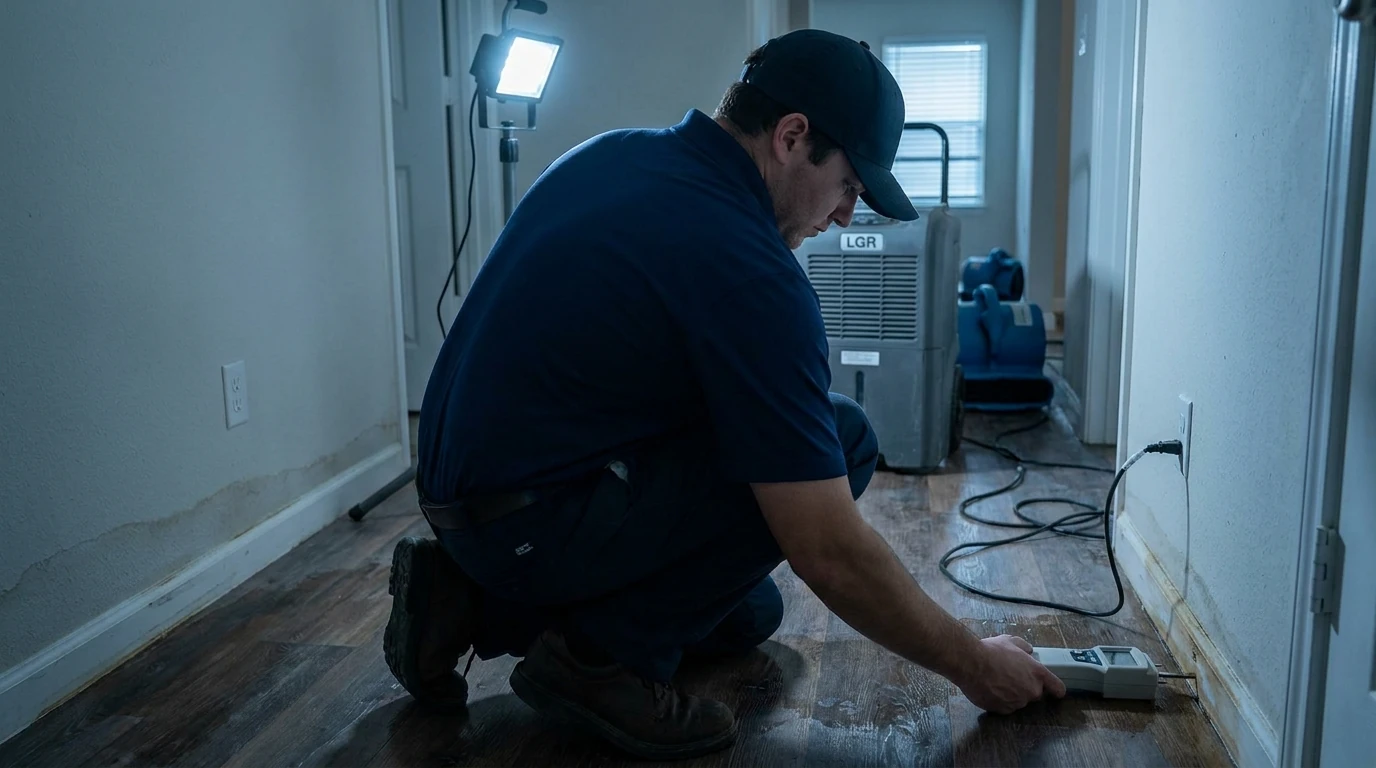
In practice that means industrial air movers and a low-grain-refrigerant dehumidifier running in the affected rooms, with a technician mapping moisture in the walls and subfloor with a meter, not just drying what’s visible. Carpet pad usually can’t be saved once it’s been wet for more than a few hours; drywall and baseboards sometimes can, if drying starts fast enough and the water was clean (what the industry calls Category 1 water). A pipe that’s been leaking slowly inside a wall for days before it finally breaks through is a different story; by then, the water may already be supporting mold growth, which changes the scope of the job.
What does homeowners insurance typically cover for a sudden pipe burst?
Most homeowners policies cover sudden, accidental water damage from a burst pipe, including the cost to tear out and dry affected materials, but typically exclude damage from a leak that was gradual or went unaddressed for an extended period, according to the Insurance Information Institute.
That distinction is why documentation matters from the first hour: photos of the standing water, moisture readings, and a written record of when the pipe failed all support a claim that this was sudden damage, not a slow leak you ignored. A restoration crew typically provides that documentation as part of the mitigation work, which is one reason adjusters usually want mitigation started before the claim is finalized, not after. Our post on whether homeowners insurance covers water damage walks through the coverage details and common denial reasons in more depth.
What happens when you call a restoration company?
The first call is a short triage conversation: where the water’s coming from, whether it’s still flowing, which rooms are affected, and whether the main valve is already shut off.
From there, a crew arrives with extraction equipment, assesses how far the water has traveled (including under flooring and inside wall cavities), and starts pulling standing water while documenting the loss with photos and moisture readings. Air movers and dehumidifiers go in the same visit to start the drying clock immediately, and the crew can typically coordinate directly with your insurance adjuster so you’re not relaying numbers back and forth yourself.
If your pipe just burst in San Marcos and water is still moving, shut off the main valve first, then Call Flood Fixers at (855) 204-1124 to get extraction and drying started while you sort out the plumbing repair separately. The burst pipe repair page and the San Marcos service page have more on how that visit typically goes in this area.