
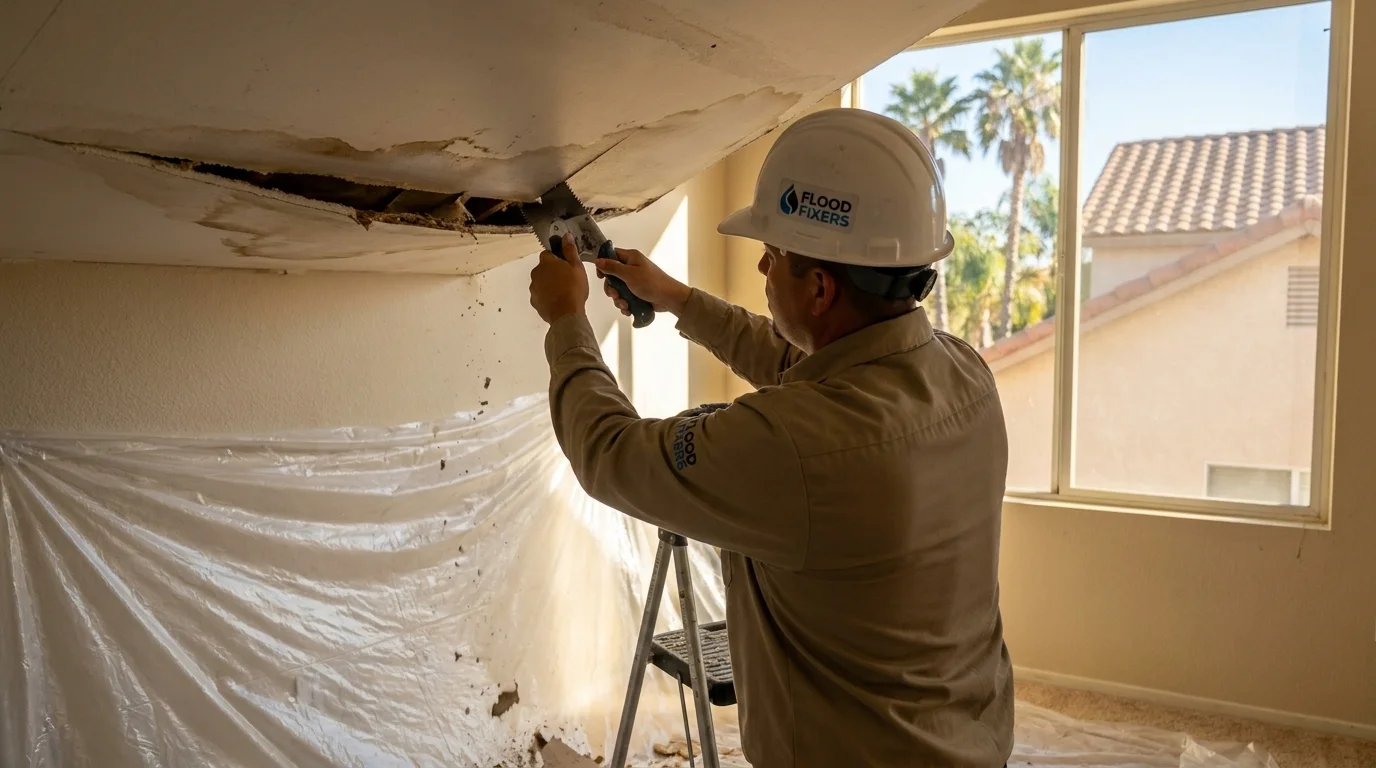
24/7 Emergency Ceiling Water Damage Repair in San Diego
24/7 emergency ceiling water damage repair in San Diego and surrounding areas. IICRC-certified, insurance billing accepted. Call (855) 204-1124.
Water coming through your ceiling right now? Call now for emergency service before the stain spreads or the drywall gives way. A ceiling leak rarely stays a ceiling problem. By the time you notice a water stain ceiling or feel a soft, spongy spot overhead, water has usually been traveling along a joist, pooling on top of drywall, or soaking into blown-in insulation for hours, sometimes days. A sagging ceiling water damage situation is a structural warning sign, not just a cosmetic one, and the source is often nowhere near the stain itself.
What ceiling water damage repair actually involves
Ceiling leak repair starts with finding the water before touching the drywall. Water follows framing, not gravity in a straight line, so a stain in the hallway might trace back to a bathroom leak two rooms over or a roof penetration near the chimney. We use moisture meters and thermal imaging to map how far the water has traveled through the ceiling cavity, insulation, and adjoining wall framing before cutting anything open. Timelines vary with the extent of saturation: a small, contained stain from a one-time leak might dry in place over a few days with targeted air movement, while a sagging section soaked by an ongoing leak usually needs the affected drywall or plaster removed, the cavity dried to documented moisture readings, and new material installed and finished to match.
Our process
- Source identification. Before any drying equipment goes in, we trace whether the water is coming from a roof leak, a failed supply line, an HVAC condensation issue, or a slab leak pushing moisture up through a wall. Repairing the ceiling without stopping the source just invites a repeat visit.
- Moisture mapping. We probe the ceiling material and surrounding framing with moisture meters to define the actual wet zone, which is almost always larger than the visible stain.
- Controlled demolition. Saturated drywall or plaster, wet insulation, and any compromised lath get removed to the dry line, not just where it looks discolored. Leaving wet material behind a fresh patch is one of the most common corner-cutting mistakes in this trade.
- Structural drying and monitoring. Air movers and dehumidifiers dry the exposed joists and surrounding framing, with moisture readings logged daily until materials reach a dry standard before any rebuild starts.
- Rebuild and finish. New drywall or plaster, texture matching, and paint bring the ceiling back to its pre-loss condition once the framing is confirmed dry.
What separates a good ceiling water damage response from a bad one
The biggest mistake in ceiling repair is cosmetic patching over a cavity that’s still wet. A quick drywall patch and a coat of paint might look fine for a few weeks, then the stain bleeds back through or mold starts developing behind the new material because the joists were never actually dried. A thorough response documents moisture content with photos and meter readings at each stage, which also happens to be exactly what insurance adjusters ask for when evaluating a claim. Another common miss is ignoring insulation: wet blown-in or batt insulation loses its R-value and can hold moisture against the drywall indefinitely even after the surface looks dry. And if the leak came from a roof or plumbing failure, a ceiling repair that doesn’t address the source, or doesn’t confirm the fix held before closing up the ceiling, is just a temporary cover.
What does ceiling water damage repair cost?
Costs depend on how much of the ceiling has to come out, whether the framing needs repair, and whether texture and paint matching is straightforward or complicated by an older home’s finish. These are typical industry ranges, not a quote: every ceiling leak is different, and Flood Fixers provides a written scope of work before any repair begins.
| Scenario | Typical range |
|---|---|
| Small stain, surface dry-out only, no demo | $300 - $800 |
| Single drywall section cut, dried, and patched | $800 - $2,200 |
| Sagging ceiling, drywall and insulation replaced | $1,800 - $4,500 |
| Plaster ceiling repair with texture matching | $2,500 - $6,000 |
| Structural joist repair plus ceiling rebuild | $4,000 - $9,000+ |
Most homeowners insurance policies cover sudden and accidental water damage, such as a burst supply line or a sudden roof failure, but typically exclude damage from long-term neglected leaks or lack of maintenance, so documentation of how and when the leak started matters for the claim.
Seasonal & regional considerations
San Diego’s rainy season, roughly December through March, is when roof-related ceiling leaks spike, especially on the flat or low-slope roofs common on mid-century homes in neighborhoods like Clairemont and Kensington. Older homes throughout the county, particularly those built before the 1970s with plaster ceilings and original copper plumbing, are also more prone to slab leaks that show up as a ceiling stain on the floor below in multi-story construction. In newer construction with HVAC units in the attic, condensation line clogs are a year-round cause of ceiling staining that has nothing to do with weather at all.
Service area
Flood Fixers repairs ceiling water damage throughout San Diego and surrounding communities, from coastal neighborhoods dealing with older plumbing to inland areas seeing more roof-driven leaks after winter storms.
If water is actively coming through your ceiling or you’ve spotted a spreading stain, don’t wait for it to sag further. Schedule your ceiling moisture assessment with Flood Fixers and get a written scope before any repair work starts.
Frequently Asked Questions
Does homeowners insurance cover ceiling water damage repair?
How do you find the source of a ceiling leak if the stain is in the middle of the room?
Can a ceiling water stain be cleaned and painted over instead of replacing the drywall?
How long does it take for a sagging ceiling to become a safety risk?
What happens if mold has already started on a wet ceiling before repair begins?
Looking for the best ceiling water damage repair company in San Diego?
Flood Fixers provides ceiling water damage repair in San Diego, CA and the surrounding area. Customers rate us 5.0 out of 5 stars across 9 Google reviews. We answer calls 24/7 — call (855) 204-1124 for immediate help.
Need Ceiling Water Damage Repair now?
We respond 24/7 across San Diego and surrounding CA cities.