
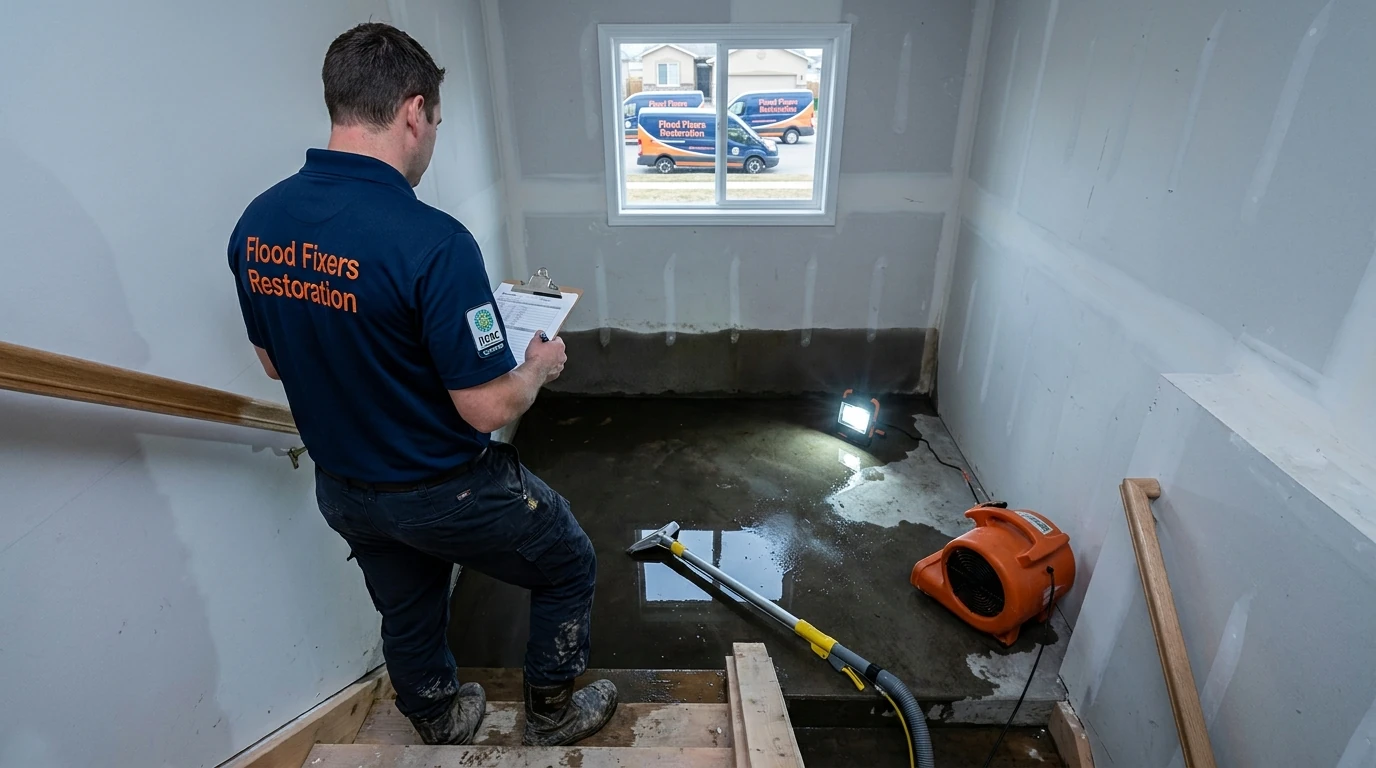
TL;DR: If water is still actively entering your basement, your first call is to a plumber or your utility company to stop the source. Once the water is off, call a water damage restoration company to extract and dry. Contact your insurance carrier after mitigation has started, not before. The order matters: stopping the source, then removing the water, then documenting for the claim.
You just walked downstairs and found standing water. Maybe it’s two inches, maybe it’s a foot. Your first instinct is probably to call someone, but who? The answer depends on one thing: is water still coming in? That single question determines your entire call order and can mean the difference between a contained loss and a gutted basement.
Is Water Still Coming In? Call a Plumber (or Shut It Off Yourself) First
If the source of flooding is still active, your first call is to a licensed plumber, not a restoration company. A restoration crew cannot safely extract water while a pipe is still flowing or a supply line is still pressurized. Stop the source first.
Before you call anyone, locate your main water shutoff and turn it off. In most homes it’s near the water meter, at the front of the house, or in a utility closet. Turning it off yourself takes 30 seconds and stops the damage from compounding while you make calls. If you cannot find the shutoff or it won’t turn, call a plumber immediately.
When is a plumber the right first call?
- A pipe burst or supply line failed and water is still running
- A water heater failed and is actively leaking
- A sump pump failed during heavy rain and water is still rising
- A main sewer line backed up and sewage is entering the basement
For sewer backups specifically, what you’re dealing with is Category 3 water, also called black water. This is contaminated with bacteria and pathogens. Do not wade through it without waterproof boots, and do not run HVAC systems that could spread airborne contaminants. A plumber clears the blockage; a restoration company handles the hazardous cleanup.
If the flooding is from an external source like a storm or groundwater intrusion through foundation walls, there is no plumber fix in the moment. Skip straight to the restoration company call.
Water Stopped? Call a Restoration Company Next
Once the source is off, your second call is to an IICRC-certified water damage restoration company. This is the call that actually limits your loss.
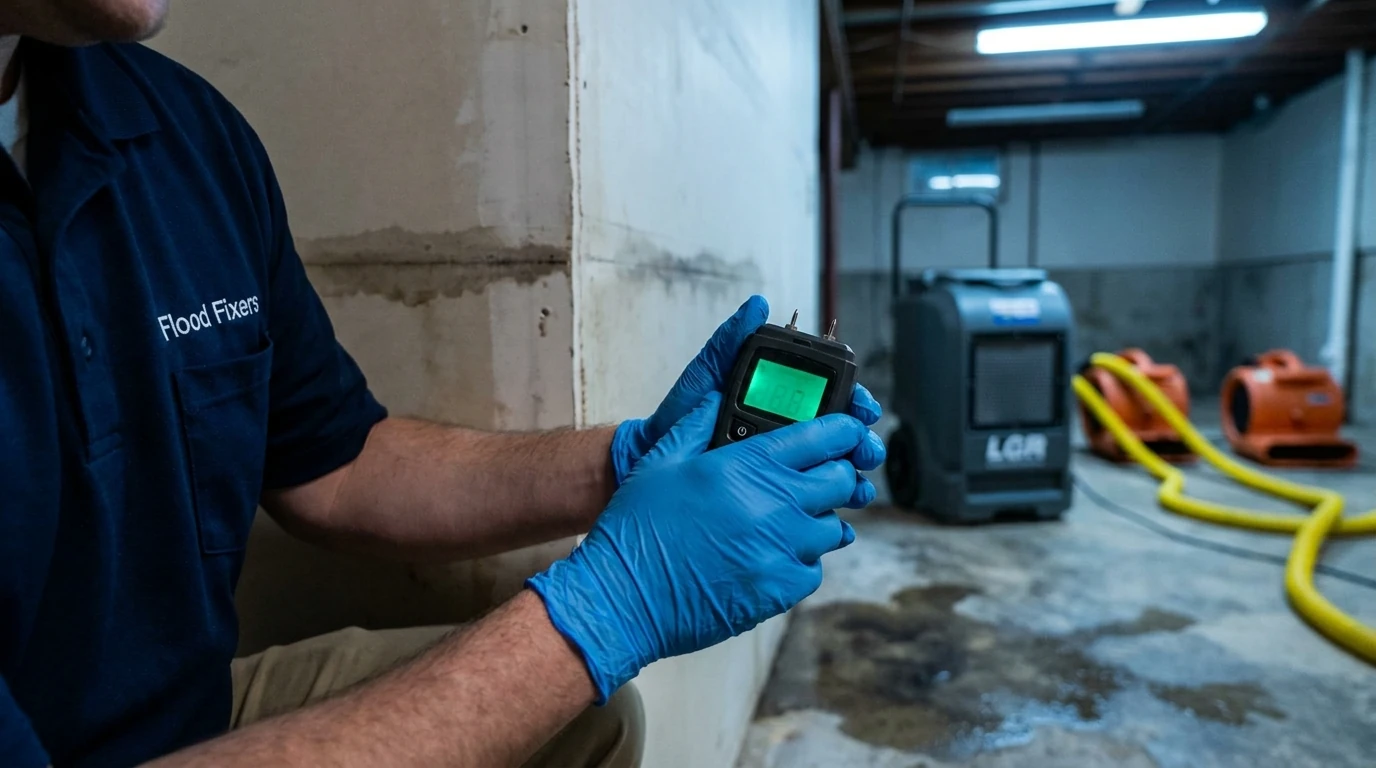
Here is why timing matters: mold can begin developing within 24 to 48 hours on wet building materials. Drywall, insulation, and wood framing absorb water fast. Every hour the water sits, the drying job gets harder and more expensive. A restoration crew brings truck-mounted extractors, LGR dehumidifiers, and high-velocity air movers to pull moisture out of the structure, not just off the floor.
What a restoration company does that a shop vac cannot:
- Extracts standing water with commercial-grade equipment (hundreds of gallons per hour)
- Reads moisture levels inside walls and under flooring with calibrated meters, not just surface feel
- Sets drying targets based on the IICRC S500 standard for water damage restoration
- Documents moisture readings with timestamps, which your insurance adjuster will need
- Identifies whether materials can be dried in place or need to be removed
For a basement flooding cleanup, a professional crew will also assess whether the water is Category 1 (clean, from a supply line), Category 2 (gray water, from an appliance drain or washing machine), or Category 3 (black water, from sewage or groundwater). The category determines the PPE required, what materials can be salvaged, and what your insurer will cover.
Flood Fixers operates 24/7 and is IICRC Certified. Call (855) 204-1124 as soon as the source is controlled.
When Do You Call Your Insurance Company?
Call your insurer after you have contacted the restoration company, not before. This surprises a lot of homeowners, but here is the logic: your policy requires you to mitigate the damage promptly. Waiting on hold with your carrier while water sits in your basement works against you, not for you.
What to do before you call the carrier:
- Photograph and video everything, including the source, the water level, and any damaged contents
- Note the time you discovered the flooding
- Get the restoration company on-site so mitigation is documented from the start
When you do call your insurer, have the following ready: your policy number, the date and time of loss, the source of the water (as best you know it), and the name of the restoration company you’ve already called. A good restoration company will handle the documentation that protects your claim, including moisture logs, drying reports, and a written scope of work.
One important distinction: standard homeowners insurance typically covers sudden, accidental water damage (a burst pipe, a failed appliance) but does NOT cover flooding from outside the home. If groundwater or storm surge entered your basement, that falls under a separate flood insurance policy through the National Flood Insurance Program (NFIP) or a private flood carrier. See our post on the difference between flood damage and water damage for a full breakdown of what each policy covers.
Also worth knowing: if you have a burst pipe that caused the flooding, that is almost always a covered peril under a standard HO-3 policy, subject to your deductible.
What About Electrical Hazards?
If there is any chance the water has reached electrical outlets, your panel, or any plugged-in appliances, do not enter the basement until the power is off. Call your utility company’s emergency line to cut power to the affected area, or flip the breaker for the basement from a dry location. Do not flip a breaker while standing in water.
If you smell gas, leave the house immediately, leave the door open, and call 911 and your gas utility from outside. Do not flip any switches.
What to Do Right Now: The Call Order in Plain Terms
Here is the sequence, simplified:
- Safety first. If there is electrical or gas risk, address it before anything else.
- Stop the water. Shut off the main or call a plumber if you cannot.
- Call restoration. Get an IICRC-certified crew extracting and drying as fast as possible. Flood Fixers is available 24/7 at (855) 204-1124.
- Document everything. Photos, video, timestamps. Do this while you wait for the crew.
- Call your insurer. Report the claim with the restoration company already on-site and mitigation underway.
If you want a step-by-step breakdown of what to do in the first hour, our burst pipe emergency checklist covers the immediate response in detail. And if you are not sure what to look for in a restoration company, our guide on choosing a restoration company walks through the questions to ask before you hire.
The worst outcome in a flooded basement is not the water itself. It is waiting too long to call the right people in the right order.
About Flood Fixers
Flood Fixers is an IICRC Certified, EPA Lead-Safe Certified restoration company serving San Diego, CA and surrounding communities including Chula Vista, Escondido, Carlsbad, Oceanside, and the greater North County region. Their crews handle water damage restoration, flood damage restoration, burst pipe repair, basement flooding cleanup, and reconstruction. Licensed and insured. Available 24/7 for emergency response at (855) 204-1124.