Mold Inspection and Testing in San Diego
24/7 mold inspection and testing in San Diego and surrounding areas. IICRC-certified, insurance billing accepted. Call (855) 204-1124.
What mold inspection and testing actually involves
A musty smell in a hallway closet, a faint discoloration spreading across a bathroom ceiling, or a string of unexplained allergy symptoms that ease up when someone leaves the house: these are the moments that send San Diego homeowners searching for answers rather than guessing. Mold inspection and testing is the diagnostic step that tells you what’s actually growing, where, and how bad it is, before anyone talks about remediation or cost.
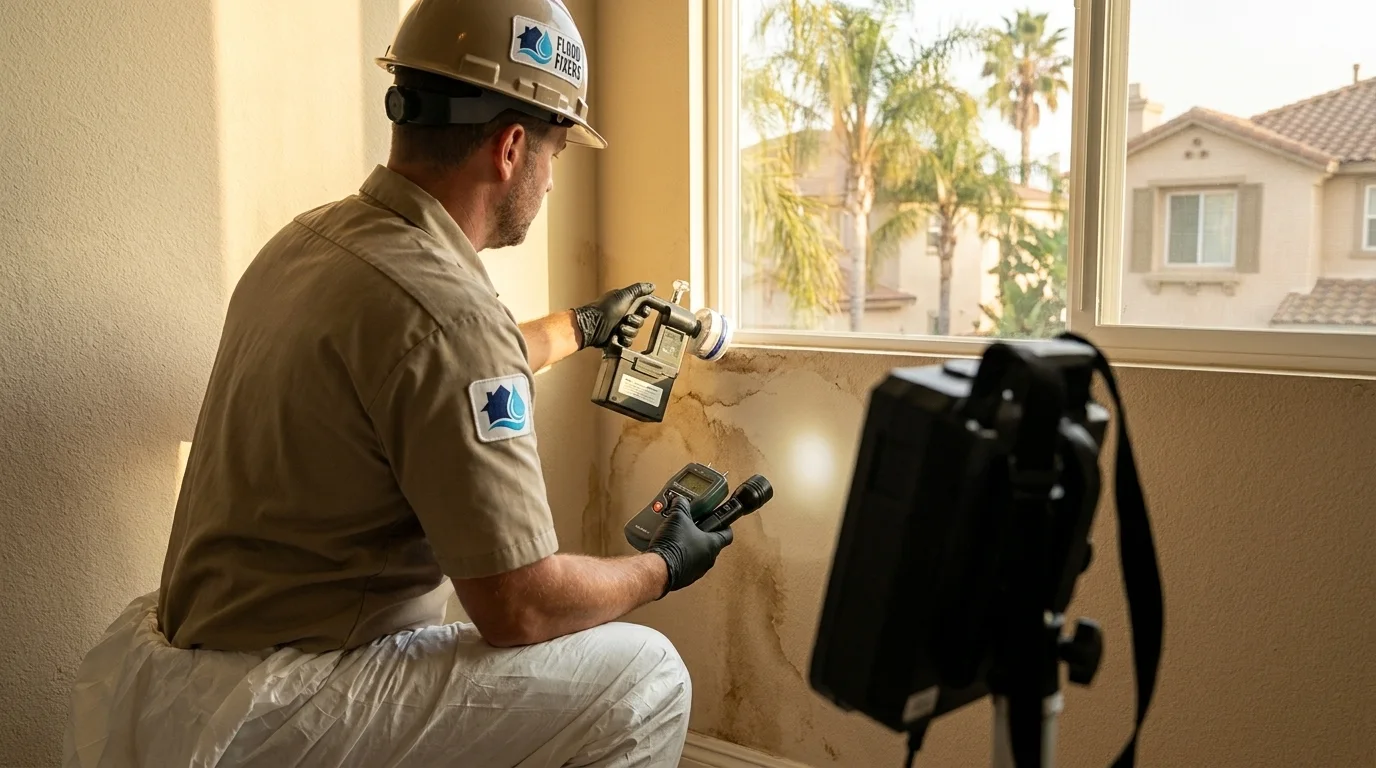
A proper inspection starts with a visual walkthrough of the property, including areas that get skipped in a casual look, crawlspaces, attic sheathing, behind baseboards near past water intrusion, under sink cabinetry, and HVAC supply and return lines. A moisture meter checks framing and drywall for elevated readings even where nothing is visible yet, since mold colonization often starts inside a wall cavity long before it reaches the surface. Where conditions suggest active growth or where a client needs documentation for a real estate transaction or health concern, air sampling and surface swabs are collected and sent to a third-party accredited lab, not an in-house test that creates an obvious conflict of interest. Results typically come back within a few business days and compare indoor spore counts and species against outdoor baseline samples, which is the standard way labs determine whether indoor air is behaving normally or not.
Our process
- Visual assessment and moisture mapping. We walk the property with a moisture meter and thermal imaging where useful, checking plumbing chases, exterior wall assemblies, attic insulation, and any area with a known or suspected history of water intrusion.
- Sample collection. Depending on what we find, we collect air samples (indoor and an outdoor control), and in some cases surface tape lifts or swabs from suspect staining, to characterize species and concentration rather than relying on a visual guess.
- Independent lab analysis. Samples go to a third-party laboratory, not analyzed by the same company recommending remediation, which keeps the results credible for insurance claims, real estate disputes, or a doctor’s request.
- Written report with findings. You get a report that lays out moisture readings, sample locations, lab results, and in cases of visible growth, an estimated scope of what remediation would involve, measured against IICRC S520 guidance.
- Clearance testing, when applicable. If remediation follows, post-work air sampling confirms spore counts have returned to a normal range before containment comes down, which is the only way to verify a job actually worked rather than just looks clean.
What separates a good mold inspection from a bad one
The most common shortcut in this industry is skipping lab testing altogether and basing a remediation recommendation purely on a visual guess or an odor. That approach misses mold growing behind non-porous surfaces, underestimates hidden moisture sources, and gives an insurance adjuster nothing to evaluate. A thorough inspection documents moisture readings at specific locations, not just a general impression, and explains why those readings matter for how far mold is likely to have spread inside a wall or subfloor.
Another gap shows up when the same company that performs the inspection also owns the lab analysis or has a financial stake in selling remediation work. Independent, accredited lab analysis removes that conflict and gives the report more weight if a dispute ever ends up in front of an adjuster, a landlord, or a buyer’s attorney during a real estate transaction. Finally, a good inspector identifies the moisture source, not just the mold. Treating visible growth without correcting the leak, grading issue, or ventilation problem behind it means the same colony reappears within weeks.
What does mold inspection and testing cost?
Costs vary with the size of the property, the number of sample locations, and whether air sampling, surface sampling, or both are needed. These are typical industry ranges, not a quote, since every property and every suspected source is different; Flood Fixers provides a written scope of sampling locations and lab fees before any work begins.
| Scenario | Typical range |
|---|---|
| Visual inspection only, single room | $150 - $350 |
| Visual inspection plus air sampling, 2-3 locations | $300 - $650 |
| Full home inspection with air and surface sampling | $500 - $1,000 |
| Pre-purchase inspection for real estate transaction | $400 - $800 |
| Post-remediation clearance testing | $250 - $500 |
Homeowners insurance typically covers mold testing only when the growth stems from a sudden, covered water event, such as a burst pipe, rather than long-term humidity or maintenance issues, so it’s worth checking your policy language before assuming coverage.
Seasonal & regional considerations
San Diego’s marine layer and coastal humidity keep indoor moisture levels elevated for much of the year, even without a recent leak, which is part of why older homes near the coast with crawlspace foundations see more inquiries than inland properties on slab. Winter rain events are the other trigger point: a roof or window leak that goes unnoticed for a few weeks during the rainy season is enough time for mold to establish inside insulation and framing before anyone notices a stain. Homes with older HVAC systems or minimal attic ventilation, common in housing stock built before current energy codes, also tend to trap humidity that keeps spore counts elevated indoors regardless of season.
Service area
Flood Fixers performs mold inspection and testing throughout San Diego and the surrounding communities, including inland valleys, coastal neighborhoods, and the older housing stock found across the county’s established neighborhoods.
If something in your home smells off, looks wrong, or just doesn’t sit right, request an air quality test and get a documented answer instead of a guess. Call Flood Fixers at (855) 204-1124 to schedule an inspection.
Frequently Asked Questions
Does homeowners insurance cover mold inspection and testing?
What's the difference between air sampling and surface sampling?
How long does it take to get mold test results back?
Do I need mold testing before buying or selling a house in San Diego?
What happens if the mold test comes back positive?
Looking for the best mold inspection and testing company in San Diego?
Flood Fixers provides mold inspection and testing in San Diego, CA and the surrounding area. Customers rate us 5.0 out of 5 stars across 9 Google reviews. We answer calls 24/7 — call (855) 204-1124 for immediate help.
Need Mold Inspection and Testing now?
We respond 24/7 across San Diego and surrounding CA cities.