
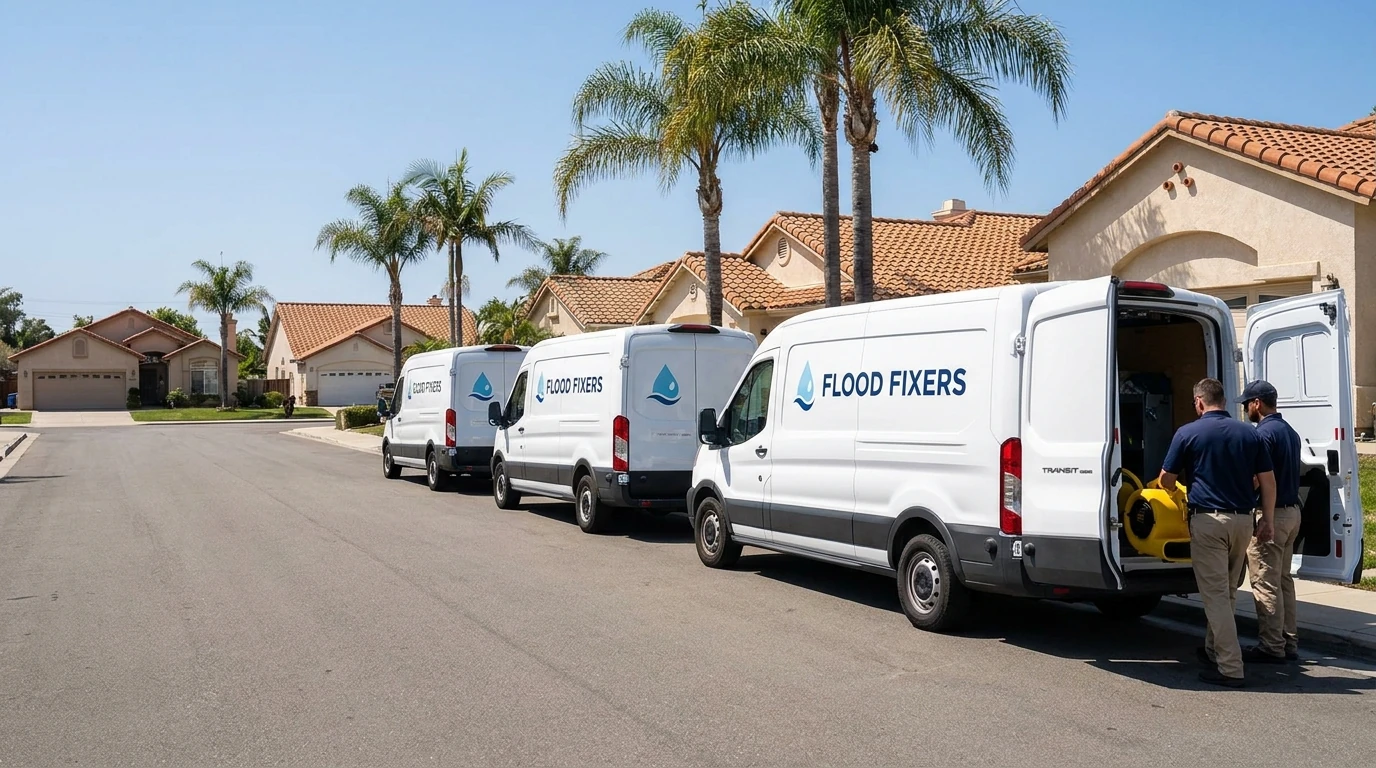
Flood Damage Restoration in San Diego
24/7 flood damage restoration in San Diego, CA. IICRC-certified, insurance billing accepted. Call (855) 204-1124.
Our technicians are headquartered right here in San Diego and are typically on-site within 60 minutes of your call.
San Diego’s reputation for sunshine is well-earned, but the region’s weather swings hard when it does break. An atmospheric river that parks over the coastal hills can dump two inches of rain in a few hours — more than some neighborhoods see in an entire year — and the city’s aging storm drain infrastructure simply wasn’t built to handle it. When that water finds its way into a home in Mission Hills, a condo in North Park, or a ground-floor unit in Ocean Beach, it moves fast, and the window for preventing secondary damage like mold closes in as little as 24 to 48 hours. Flood Fixers is based here in San Diego, and our crews are on the road — not dispatched from a regional call center — when you call (855) 204-1124.
Why San Diego Properties Are Vulnerable to Flood Damage
San Diego’s soil profile is a significant factor most homeowners never think about until water is pooling in their living room. Large stretches of the city sit on expansive clay soils — particularly in inland neighborhoods like Kensington and Talmadge — that absorb moisture slowly and can shift under a slab foundation when they do. That means a sustained rain event doesn’t just flood a yard; it can drive water laterally through foundation cracks and under door thresholds into finished living space.
The housing stock compounds the problem. A large share of single-family homes in older San Diego neighborhoods were built between the 1930s and the 1960s, often with raised-wood or slab foundations and minimal waterproofing by today’s standards. Stucco exteriors, common throughout the region, can mask water intrusion for weeks before visible damage appears inside. ZIP code 92103 — covering Mission Hills and Hillcrest — has a particularly dense concentration of these older craftsman and Spanish-revival homes, and we see a predictable uptick in flood-related calls there after every significant storm.
Our Flood Damage Restoration Process in San Diego
The first priority when we arrive is stopping ongoing water entry and documenting everything with moisture mapping and thermal imaging before a single piece of furniture moves. Insurance adjusters — and San Diego has a high concentration of policies through CSAA and Farmers given the state’s carrier landscape — want photographic evidence of conditions as-found, not after extraction has already started.
From there, the process moves through extraction, structural drying, and content evaluation in a sequence calibrated to the specific materials in your home. Hardwood floors common in North Park bungalows respond differently to drying than the tile-over-concrete slabs you find in newer Mission Valley condos. We set drying targets based on psychrometric readings, not a fixed number of days, and we monitor daily until the structure reaches equilibrium. Once the structure is dry, any damaged drywall, insulation, or flooring is removed and documented before reconstruction begins.
Response Time Across San Diego
Flood Fixers operates out of San Diego, which means our drive times are real, not estimated from a warehouse in Riverside. From our location, we can typically reach Ocean Beach or Point Loma in under 30 minutes, and neighborhoods further east like El Cajon or La Mesa in 35 to 45 minutes depending on I-8 traffic. We run a 24-hour dispatch line — (855) 204-1124 — because water damage at 2 a.m. on a Tuesday is not a business-hours problem.
San Diego Insurance Coordination
California’s insurance market has gotten complicated. Several major carriers have reduced their residential footprint in the state, and homeowners in San Diego are increasingly carrying policies through the FAIR Plan or smaller surplus-line insurers that have different documentation requirements than a standard HO-3. We’ve worked with enough of these claims locally to know what each type of adjuster needs: itemized moisture logs, IICRC-standard drying records, and photo documentation at each phase of the job. We provide all of it as a standard part of the file, and we communicate directly with your adjuster so you’re not playing telephone between two parties who speak different technical languages.
Local Note
One thing that surprises homeowners in San Diego’s hillside neighborhoods — places like Mount Washington adjacent areas and the canyon-rim streets above Mission Valley — is that flood damage often enters from uphill, not from below. When saturated soil on a slope above a property gives way, water can sheet across a yard and enter through weep screeds at the base of a stucco wall, a gap that’s almost invisible until it’s already wicking into the wall cavity. We check those entry points specifically on any hillside property, because missing them means the structure never fully dries regardless of how many air movers you run inside.
If your San Diego home or rental property has taken on water — whether from a storm, a failed sump, or a backed-up drain — call Flood Fixers at (855) 204-1124. The sooner extraction starts, the smaller the reconstruction scope, and the faster you’re back in a dry, safe home.
Flood Damage Restoration in San Diego: Service Coverage Map
Frequently Asked Questions
How fast can you arrive for flood damage restoration in San Diego?
How quickly can Flood Fixers reach a home in Ocean Beach or Mission Hills after a flood call?
Are older craftsman homes in North Park or Kensington harder to dry out after flood damage?
San Diego's FAIR Plan or surplus-line insurance policies — do you work with those for flood damage claims?
What's the realistic timeline for flood damage restoration in a typical San Diego home?
Does San Diego's expansive clay soil affect flood damage work differently than other regions?